About Ensis leei M.Huber, 2015
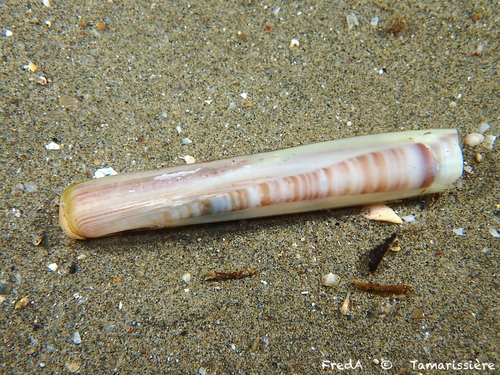
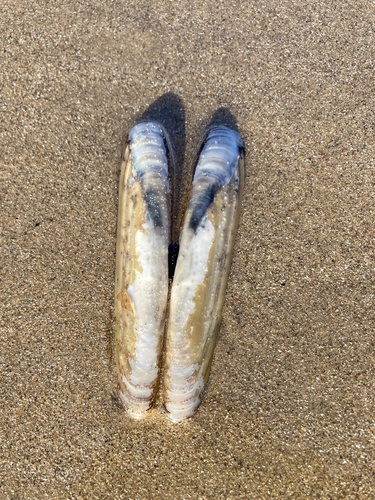
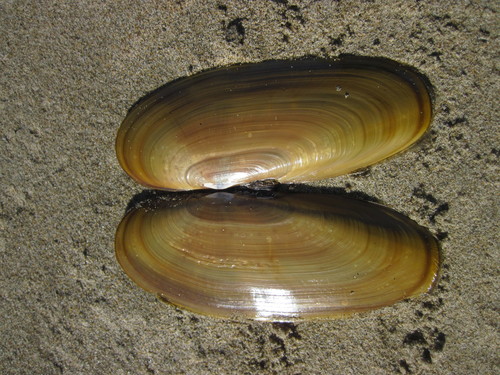
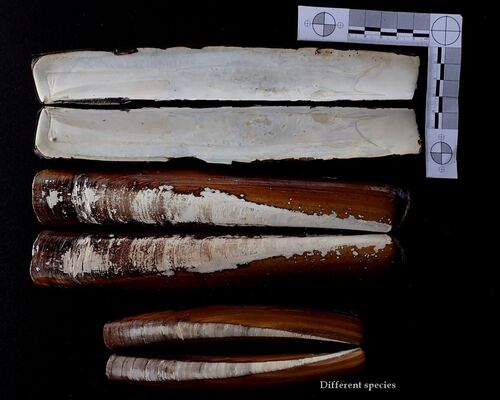
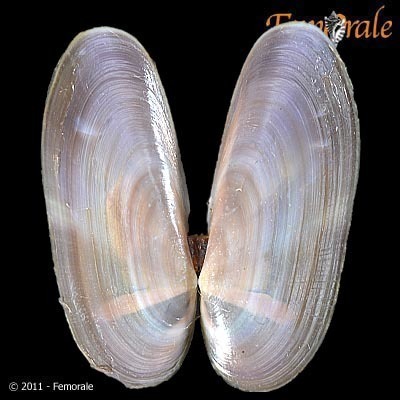
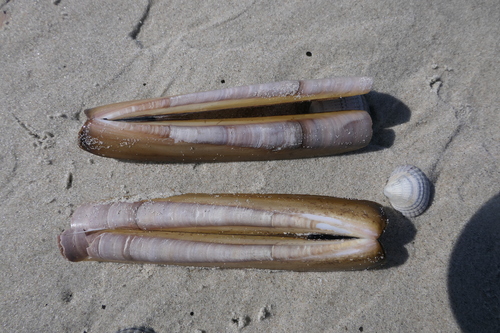
Ensis leei M.Huber, 2015, commonly called the Atlantic jackknife clam, is also known by the common names bamboo clam, American jackknife clam, or razor clam. It is a large edible marine bivalve mollusc native to the North American Atlantic coast, ranging from Canada to South Carolina. This species was introduced to Europe at the end of the 1970s, and is already extremely abundant there in suitable habitats. Note that the name "razor clam" is also used for other unrelated species, including the Pacific razor clam (Siliqua patula) and the Razor shell (Ensis magnus).
Atlantic jackknife clams inhabit sand and mud in intertidal or subtidal zones of bays and estuaries. Their streamlined shells and strong feet let them burrow very quickly into wet sand. They can also swim by propelling jets of water out of their shells. The species gets its common name from the extremely sharp rim of its shell, and its overall shape that strongly resembles an old-fashioned straight razor. Beachgoers can be injured if they accidentally step on one of these shells. At low tide, a keyhole-shaped opening in the sand reveals the clam's position; when disturbed, the clam squirts a small jet of water from this opening as it begins to dig. This species is so fast at digging that it can easily outpace a human digger, making it very hard to catch. Amos Winter of MIT has studied how these razor clams bury themselves, in part using a repurposed ant farm and glass beads. Because they are so difficult to catch, the species is not often commercially fished, even though it is widely considered a delicacy. In coastal Massachusetts, local people seek them out in summer to make homemade clam strips, and most towns have local ordinances that limit how many clams can be collected at a time. The easiest way to catch Atlantic jackknife clams is to pour salt onto their characteristic breathing holes; the clam will move up out of its hole to escape the salt, at which point you can gently grab its shell and pull it out of the ground.
Predators of Ensis leei (previously referred to as Ensis directus in this text) include humans, plus birds such as the ring-billed gull (Larus delawarensis) in North America and the Eurasian oystercatcher (Haematopus ostralegus) in Europe, and the nemertean worm Cerebratulus lacteus. Today, the Atlantic jackknife clam is established in northwestern Europe, where it is considered a harmful exotic species, though it is also commercially exploited there. It was first recorded in Europe in 1978/1979, in the Elbe estuary. The digging method of the Atlantic jackknife clam has inspired a biomimetic anchor that is currently in development by a team at the Massachusetts Institute of Technology. This anchor adapts the clam's digging approach to help hold undersea cables, and potentially watercraft, securely in place.