About Ensifera ensifera (Boissonneau, 1840)
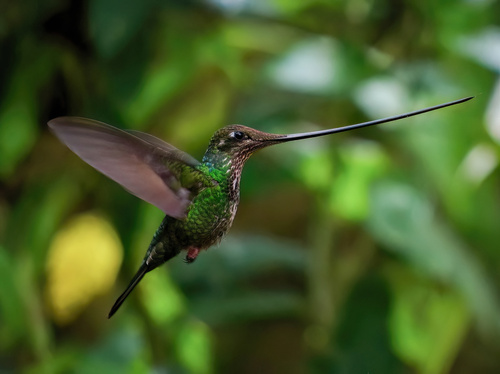
The sword-billed hummingbird, with the scientific name Ensifera ensifera, is among the largest hummingbird species. Excluding the bill, adult individuals measure 13–14 centimetres (5.1–5.5 in) in length and weigh 10–15 g (0.35–0.53 oz). On average, males are slightly larger than females. The most distinctive trait of this species is its extremely large bill, which measures 8–12 centimetres (3.1–4.7 in) long. This bill is the longest of any hummingbird, and it is also the longest bill relative to body length of any living bird. It is the only known bird whose bill is longer than the rest of its body when the tail is excluded. The bill is black, heavy, and slightly upturned. This extremely long bill allows the sword-billed hummingbird to feed from flowers with long corollas that other bird species cannot access. This species shows clear sexual dimorphism. Males have shorter bills, but longer wings and tails, than females. Males have bronze-green upperparts, coppery-bronze heads, a small white spot behind the eye, dusky throats, metallic green underparts, and a dark gray belly. Their tail is forked, blackish, and bronze-green, and some males have white markings on the chin and throat. Females have similar upperparts to males, but have white underparts, with grayish throats and bellies speckled with green. Their tail is less deeply forked and has grayish white edges. Juvenile sword-billed hummingbirds have a similar appearance to females. Sword-billed hummingbirds live in the Andes Mountains, ranging from western Venezuela through Colombia, Ecuador, and Peru all the way to Bolivia. They occupy humid and wet montane forests, forest edges, shrubland, gardens, and patches of páramo, at elevations between 1,700–3,500 m (5,600–11,500 ft). The species is most common at elevations of 2,400–3,100 m (7,900–10,200 ft). It is generally non-migratory, but makes localized movements in Colombia and northwestern Venezuela: it moves to higher altitudes in the early wet season, and returns to lower elevations during the dry season. Its distribution closely matches the distribution of species from the subgenus Tacsonia in the genus Passiflora, a pattern driven by its highly specialized bill and feeding habits. Like other hummingbirds, the sword-billed hummingbird is able to fly backwards and hover in place. It also has higher than average wing-disk loading compared to other members of the hummingbird family. Breeding activity for this species takes place from February to March. Its nests are cup-shaped, built from moss, and are typically hung among root fibers high above the ground.