About Ensete ventricosum (Welw.) Cheesman
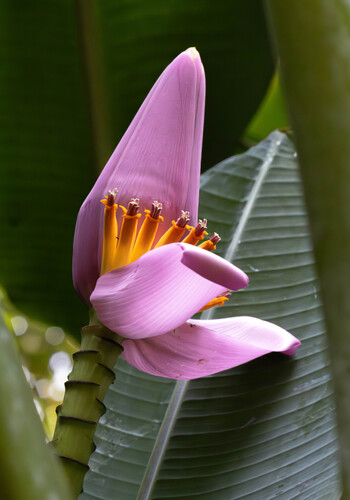
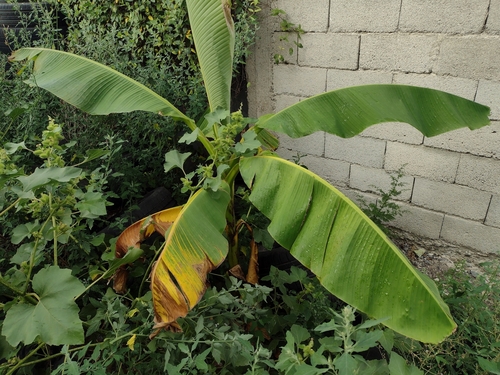
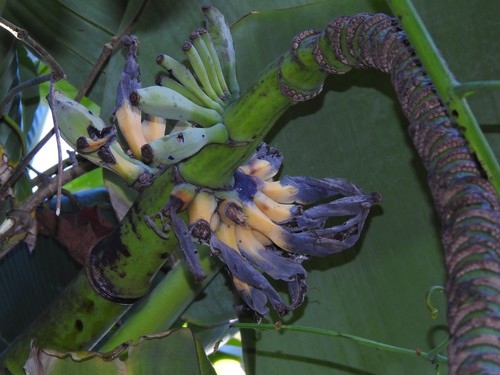
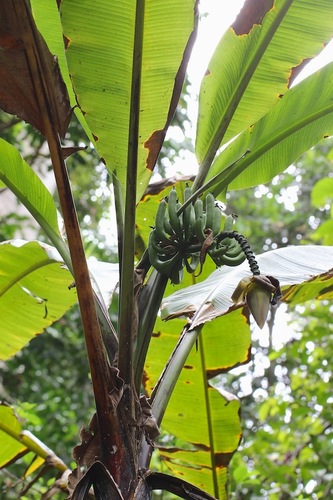
Ensete ventricosum (Welw.) Cheesman is a large non-woody monocarpic evergreen perennial, similar in appearance to the banana. It typically grows up to 6 m (20 ft) tall, though the tallest recorded individual reached 13 m (43 ft). It forms a stout pseudostem made of tightly overlapping leaf bases, and bears large banana-like leaf blades. The most commonly reported maximum leaf dimensions are 5 m (16 ft) tall by 1 m (3 ft 3 in) wide, though leaves up to 6 m (20 ft) long and 1.5 m (4 ft 11 in) wide have been documented. Flowers grow only once, emerging from the centre of the plant at the end of its life, arranged in large pendant thyrses up to 3 m (9.8 ft) long. These inflorescences hold 30 or more clusters of small banana-shaped structures, covered by large pink bracts. The plant’s roots are an important food source, while its inedible fruits contain hard, black, rounded seeds. Its Latin specific epithet ventricosum translates to "with a swelling on the side, like a belly".
Enset, the common name for this plant, is a very important local food source, particularly in Ethiopia. In 1995, the Food and Agriculture Organization of the United Nations reported that enset produces more food per unit area than most cereals. It is estimated that 40 to 60 enset plants growing on 250–375 square metres (2,700–4,000 sq ft) can provide enough food for a family of 5 to 6 people. Enset is Ethiopia’s most important root crop, and a traditional staple in the densely populated south and southwestern regions of the country. Jerónimo Lobo first recorded its importance to the diet and economy of the Gurage and Sidama peoples in the seventeenth century.
Each plant takes four to five years to mature; at maturity, a single root yields about 40 kg (88 lb) of food. Because of this long growing period from planting to harvest, plantings must be staggered over time to ensure enset is available for harvest every season. Enset tolerates drought better than most cereal crops. Wild enset plants grow from seeds, while most domesticated plants are propagated from suckers; a single mother plant can produce up to 400 suckers. In 1994, 3,000 km2 (1,200 sq mi) of enset were cultivated in Ethiopia, with an estimated harvest of almost 10 tonnes per hectare (4.0 long ton/acre; 4.5 short ton/acre). Enset is often intercropped with sorghum, though the Gedeo people traditionally intercrop it with coffee.
The young tender growing tissues at the centre or heart of the plant are cooked and eaten; they are nutritious and similar in texture to palm or cycad core. More than 150,000 hectares (370,000 acres; 580 mi2) of enset are cultivated in Ethiopia to produce a starchy staple food made from pulverized trunk and inflorescence stalk. Fermenting these pulverized parts produces a food called kocho. Bulla is made from the liquid squeezed out of the pulverized mixture, and is sometimes eaten as porridge, while the remaining solids can be eaten after a several-day settling period. Mixed kocho and bulla can be kneaded into dough, which is then flattened and baked over a fire. In some areas, kocho is considered a delicacy suitable for feasts and ceremonies such as weddings, where wheat flour is added. The fresh corm is cooked like potatoes before eating. Dry kocho and bulla are energy-rich, providing 14 to 20 kJ/g (3.3 to 4.8 kcal/g). It is a major staple crop, though it is often supplemented with cereal crops. Its value as a famine food has declined for a number of reasons, detailed in the April 2003 issue of the UN-OCHA Ethiopia unit’s Focus on Ethiopia: Apart from an enset plant disease epidemic in 1984–85 that wiped out large portions of plantations and caused the "green famine", major contributing factors over the preceding 10 years were recurrent drought and food shortage, combined with acute land shortage that forced farmers to increasingly harvest and consume immature plants. This overexploitation of enset reserves led to gradual losses and disappearance of false banana (another common name for enset) as an important household food security reserve. Even when accounting for other causes of plant loss, estimates indicate that more than 60% of false banana crop stands have been lost in some areas of the SNNPR over 10 years. This means many people who previously closed food gaps with false banana consumption can no longer do so, and without viable alternatives, have become food insecure and highly vulnerable to climatic and economic disruptions to their agricultural systems.
Enset provides a good quality fibre obtained from its leaves, suitable for making ropes, twine, baskets, and general weaving. Dried leaf-sheaths are used as packing material, serving the same function as foam plastic and polystyrene in Western contexts. The entire plant except the roots is used to feed livestock. Fresh leaves are common cattle fodder during the dry season, and many farmers feed harvest or processing residues to their animals.
Gender roles in enset cultivation are highly important, with a strong division of labour. Men are generally responsible for propagation, cultivation, and transplanting of enset, while women handle manuring, hand-weeding, thinning, and landrace selection. Women also process enset plants, a laborious task that transforms the plant into usable materials (primarily food and fibres), and women typically work together for this step; men are not allowed on the field during processing. Because women are responsible for providing enough food for their family, they also decide when to harvest, which plants to harvest, and what quantity to sell. Multiple studies note the importance of women’s knowledge of different enset crop varieties; women are more likely than men to accurately identify the plant’s different varieties. Even so, women’s work is often neglected or considered less important than men’s work by both researchers and farmers, and women are less likely than men to access extension services and quality agricultural services.
Gender also influences the classification of enset varieties, which are differentiated into "male" and "female" types based on the preferences of the men and women who harvest them. Men generally prefer late-maturing genotypes that are resistant to disease, while women prefer varieties that cook well and can be harvested for consumption at an earlier stage.
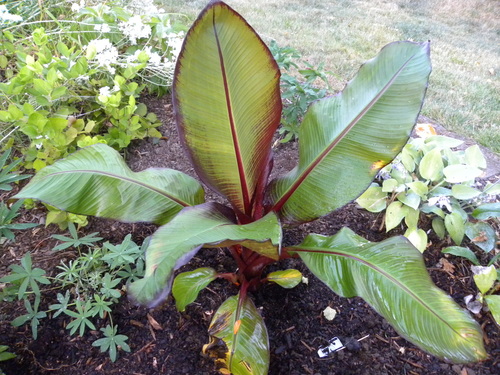
This quick-growing plant is often cultivated as an ornamental. In areas prone to frost, it requires winter protection under glass. Both the species and its cultivar 'Maurelii' (Ethiopian black banana) have gained the Royal Horticultural Society's Award of Garden Merit.