About Enoplognatha ovata (Clerck, 1757)
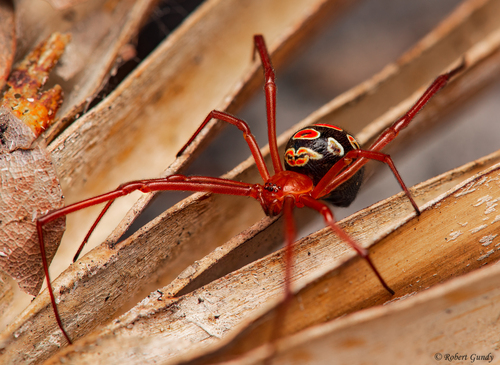
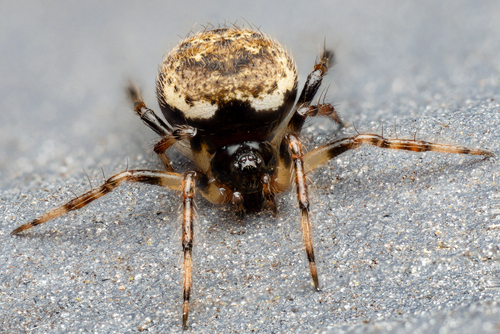
Enoplognatha ovata (Clerck, 1757) reaches a body length of 6 millimeters when legs are excluded. This species has translucent legs and a globular abdomen that is extremely variable in color and pattern. The abdomen's background color is most commonly white, cream, or green, and may be marked with a row of dark spots, a broad red stripe, or two red stripes arranged in a V-shape. Coloration can usually be sorted into three distinct morphs. The "Lineata" morph has a yellow or cream-colored opisthosoma; "Redimita" features a pair of red dorsal stripes; the "Ovata" morph has a fully red dorsal area, which is the rarest variation, occurring only sporadically in populations. To the naked eye, mature Enoplognatha ovata are essentially indistinguishable from the related species Enoplognatha latimana. The two species can only be told apart by examining the male palpal bulb and female epigyne of mature individuals. All the color patterns found in E. ovata also occur in E. latimana, where the "lineata" morph is the most common. This spider is native to Europe and has been introduced to North America. It has been notably recorded in Lithuania, and in the United States it occurs from coast to coast, but does not range as far south as Mexico. It inhabits open fields, forests, and roadsides, and is typically found on the underside of leaves within low-growing vegetation. Populations often form dense clumps, sometimes referred to as colonies. Female E. ovata deposit their eggs in an initially white egg sac. Over several days, the sac gradually changes color to blue or grey. The egg sac is placed inside a rolled-up leaf that is fastened together with silk, and the female guards it until the eggs hatch. Mother spiders have been observed defending their eggs from predators, and even provisioning prey for their newly hatched spiderlings. The web of this species is typically a small mass of tangled threads, located on the underside of a leaf. Silk threads usually pull the edges of the host leaf down slightly to create a hidden shelter, a feature that can be used to help locate these webs.