About Enoplochiton echinatus (Barnes, 1824)
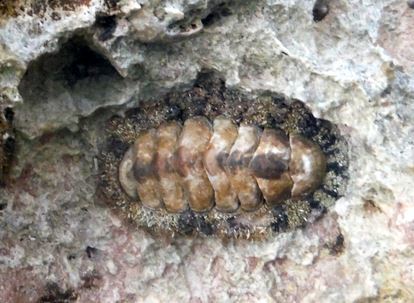
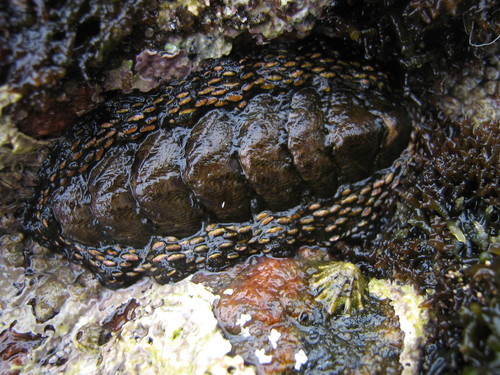
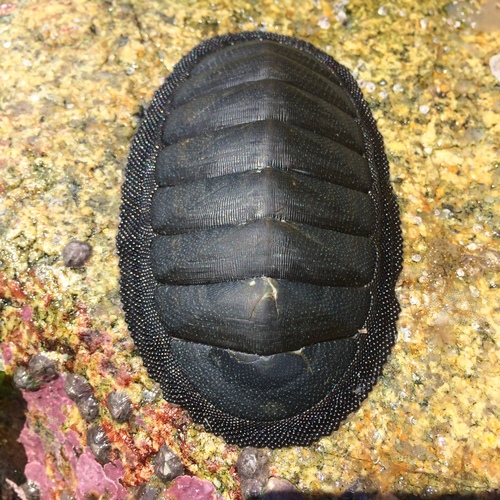
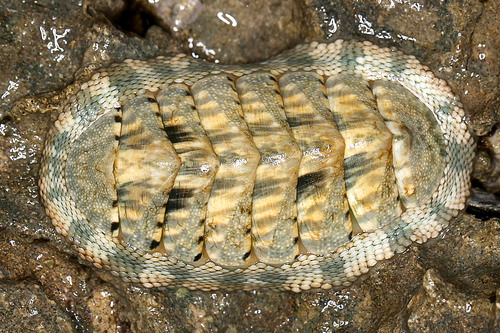
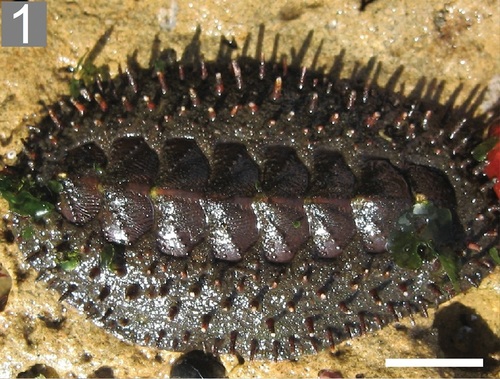
Enoplochiton echinatus (Barnes, 1824) is a very large species of chiton. Confirmed specimens measure up to 23 cm (9.1 in) in length; across its Chilean range, the largest individuals are found in the north, while the smallest occur in the south. The species has a very dark reddish-brown body. Its plated shell, which is often covered by epibionts including algae, Scurria limpets, and Mytilus mussels, bears many spines. In large individuals, these spines are generally up to 0.8 mm (0.03 in) long; unbroken spines may be longer, though unbroken longer spines are unusual. The similar-sized sympatric species Enoplochiton niger lacks these spines. The distribution of Enoplochiton echinatus extends along the Pacific coast of South America, from Concepción Province (Punta Tumbes) in Chile north to Talara in Peru. Old claims of this species occurring in the Galápagos Islands are considered incorrect. It lives at depths between 0 and 4 m (0 and 13 ft) in the intertidal and shallow subtidal zones, with the vast majority of individuals found in the lower intertidal zone. It inhabits rocky coasts in areas that frequently experience heavy surf, and its habitat often contains the giant kelp Lessonia nigrescens. The species is generally quite common; in suitable habitat, average densities typically range from around 1.5 to 2.5 individuals per square meter. It is an omnivore that feeds on a wide variety of algae and invertebrates. It has notably large radular teeth, which let it consume heavily incrusted organisms like coralline algae. Enoplochiton echinatus is edible, and it is one of the few commercially important chitons in its native range. The other commercially important chitons in the area are Chiton magnificus, a somewhat smaller (up to 17.4 cm, or 6.9 in) dark bluish-gray species, and Chiton granosus, a much smaller (up to 4.5 cm, or 1.8 in) brownish species; neither of these two species has large spines.