About Enneacanthus gloriosus (Holbrook, 1855)
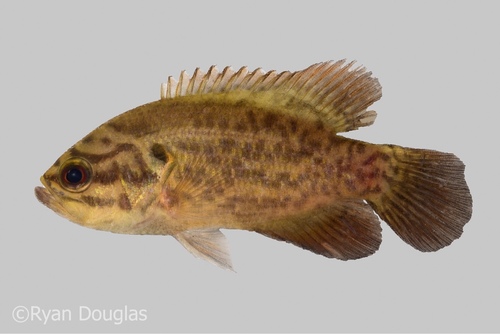
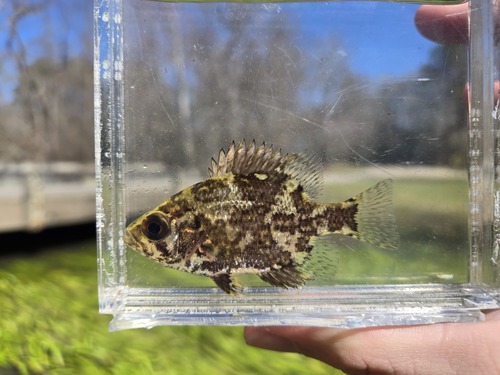
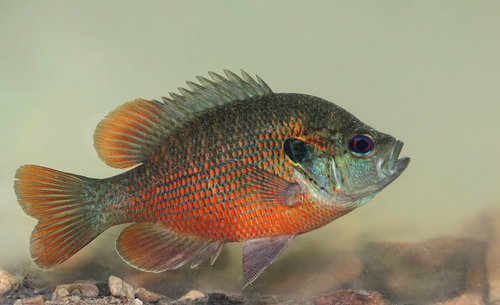
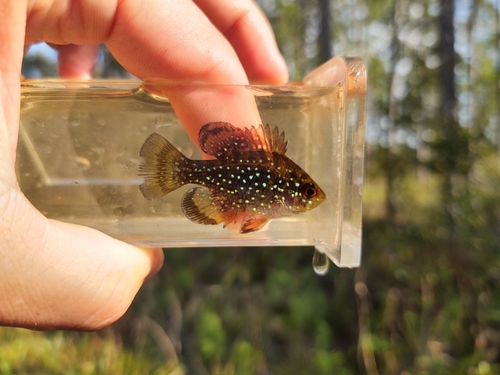
Enneacanthus gloriosus reaches a maximum total length of around 9.5 centimeters (3.7 inches), making it one of the smallest species in its family. It has spines in both its dorsal and anal fins, and its tail fin has a rounded outline. The body is covered in white or blue dots, and some individual fish have iridescent spots. A small number of pale bars may appear on the fish’s sides, though this is rare, especially in adult individuals. Several species of parasitic flatworms have been found in this fish, including Gyrodactylus gloriosi and multiple Urocleidus species. Many life history traits of this fish differ across geographic regions. For example, individuals living along the Eastern Seaboard grow larger than those found in Mississippi. Fish reach sexual maturity at larger body sizes at more northern latitudes; this may be because fish in milder southern climates can start investing energy in reproduction earlier, directing energy toward gonadal growth instead of body growth when they are younger. Eastern populations can reach a maximum age of around five years, while southern populations generally do not live this long. The spawning season is also much longer in southern regions, likely due to warmer temperatures and longer daylight periods there. This is a freshwater fish that lives in ponds, lakes, creeks, streams, and medium-sized rivers. It can tolerate slightly brackish water in coastal areas, and it thrives in small backwaters filled with aquatic vegetation and tree roots. This species is sometimes kept as a pet in aquariums. The fish spawns multiple times in a single spawning season, and may spawn daily over a long period. The male builds a spawning nest in the substrate or within plant material. Observed clutch sizes for this species range from 42 to 216 eggs.