About Enneacanthus chaetodon (Baird, 1855)
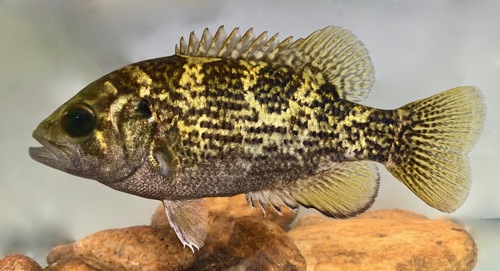
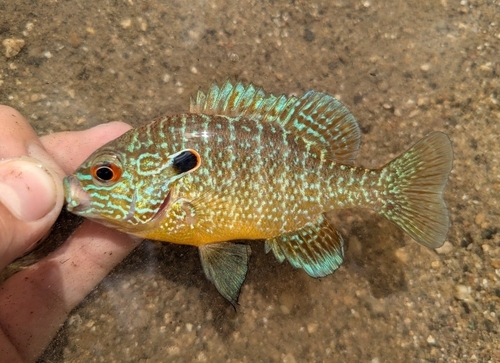
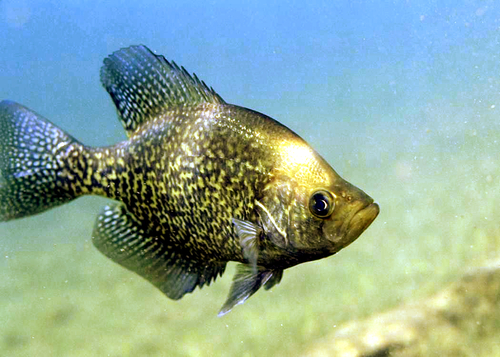
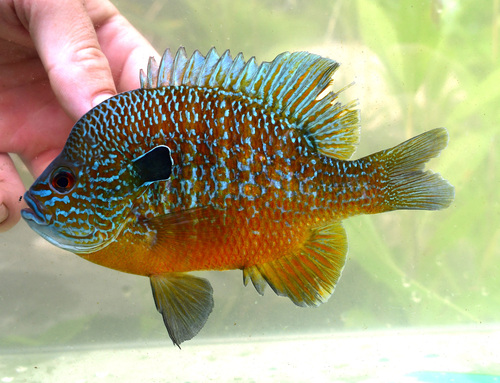
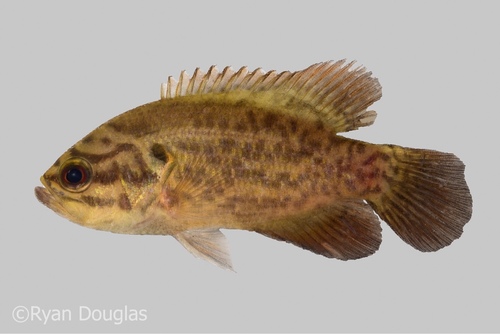
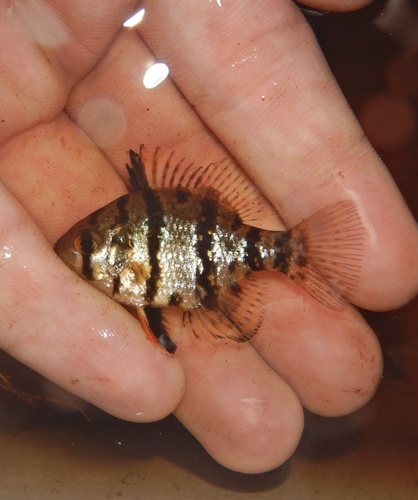
The blackbanded sunfish (scientific name Enneacanthus chaetodon (Baird, 1855)) is a fairly small fish, reaching a maximum length of 10 cm, with an average length around 6 centimeters and an average lifespan of 3–4 years. It has a very compressed, deep body, a small mouth, and a large lower jaw that extends upwards. A black spot appears on its gill cover, and its dorsal (top), anal (bottom rear), and caudal (tail) fins are marked with black mottling. Its upright dorsal fin has 10 spines, and its tail fin is somewhat rounded. Most of its body is shiny silver with yellow spots. The species gets its common name from six black vertical lines on each flank; the first line runs through the eye, and the remaining five extend back toward the tail fin. Blackbanded sunfish are found in the United States, ranging from New Jersey to central Florida. Unconfirmed reports note their presence in the Delaware Valley, but no specimens have ever been successfully collected from this area. This species lives only in shallow, low-velocity, non-turbid waters of lakes, ponds, rivers, and streams. They are strongly associated with aquatic plants, which provide them with foraging habitat and protective cover. Blackbanded sunfish populations have declined in recent years due to poor water conditions and pollution. Like other sunfish, male blackbanded sunfish claim a nest site, typically located among aquatic plants. Females lay their eggs in the prepared nest, after which males drive the females away. Males guard the eggs until they hatch, and may continue guarding for up to a week after hatching until the fry become free-swimming.