About Enicurus schistaceus (Hodgson, 1836)
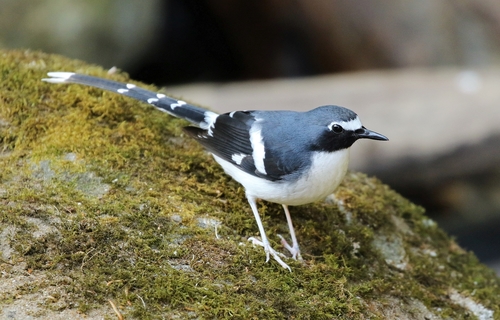
The slaty-backed forktail, scientifically named Enicurus schistaceus (Hodgson, 1836), is a slim, medium-sized forktail. Adults measure 22 to 25 centimetres (8+5⁄8 to 9+7⁄8 inches) long and weigh 26 to 38 grams (0.92 to 1.34 ounces). Their plumage is a combination of slate-grey, black, and white. The bill is black, feet are pale pinkish or greyish, and the iris is most often dark brown, though some specimens have black irises. The species has a black throat and a narrow white stripe running across the face to just behind the eyes, which is sometimes called a white mask; this stripe may include a complete or partial white eye ring. Ear coverts, chin, and face are also black. The forehead, crown, sides of the neck, and scapulars are slate grey. Wing-coverts are black, with a white patch at the base of the primaries, wide white bars on otherwise black wings, and a large white patch on the rump and lower back. The bases of flight feathers are white, which occasionally appears as an extra small bar on the wing. The tail is long, evenly graduated, and has a deep fork; it is mostly black with a white tip, plus three additional white bands along its length formed by the white tips of shorter tail feathers.
Juveniles differ from adults: they lack a white forehead, are brown above, have dark scaling on the breast, a shorter tail than adults, greyish or yellowish lores, a greyish or white chin and throat, and dull grey-brown flanks. This species is not sexually dimorphic. Some specimens have white-tipped primaries; this trait is not sex-linked, occurs across the species’ entire range, and has been hypothesized to result from aging or feather wear. It is very similar to the black-backed forktail Enicurus immaculatus, but is distinguished by its slate-grey mantle and crown (from which it gets its common name), a slightly larger bill, and slightly less white on the forehead.
The slaty-backed forktail lives near fast-flowing water bodies in tropical and subtropical montane broadleaf forests, and also near cultivated areas. These water bodies include rocky streams and rivers, even broad rivers and valleys in plains areas. A 2000 study of birds in northwest India and Nepal found that the occurrence of slaty-backed forktails decreases with increasing altitude. This study also found the species prefers streams bordered by dense, complex vegetation with firm, stable earthen banks, streams with fine-grained sand on the bottom, and streams with pool–riffle sequences. Less often, the bird is seen in secluded forest areas, or on the sides of roads or trails near water. In winter, it moves from mountains into foothills and plains areas.
Its range extends across the central and eastern Himalayas, from the Indian state of Uttarakhand in the west to Myanmar in the east, including Nepal and Bhutan. It is a vagrant in Bangladesh. It also occurs in southern China, in southeast Tibet, and the provinces of Sichuan, Yunnan, Guizhou, Fujian, and Zhejiang, and possibly occurs in Hainan. In Southeast Asia, its range includes Thailand, Vietnam, Laos, Cambodia, peninsular Malaysia, and Hong Kong; in Hong Kong, it is only an occasional winter visitor or very rare resident, and its distribution across Southeast Asia is discontinuous. The species’ elevational range varies by location: it has been recorded at 300–1600m above sea level in northern India, 900–1675m in Nepal, 400–1800m in southern China and adjacent areas of Thailand, above 500m in Cambodia, above 800m in Malaysia, and 800–2200m in Bhutan. In winter, it has been recorded as low as 200m above sea level.
The species’ total range is not precisely mapped but is known to be very large. Its population is thought to be stable; while the exact population size is unknown, it is estimated to be greater than 10,000 individuals. The International Union for Conservation of Nature categorizes this species as least concern. It is common in the parts of its range in China, Nepal, and Southeast Asia.
The slaty-backed forktail breeds between February and July, and this breeding period does not vary across its range. It builds its nest from bryophytes, leaves, and grass; the nest is shaped like a cup or partial dome depending on its construction site, and it often has an outer layer of mud. Nests are most often built in holes in the ground or tree trunks, between tree roots, in dead tree hollows, and sometimes in rock crevices. The bird lays three to four eggs, which range in colour from pure white to pinkish white to bluish white, with lavender or reddish brown spots that are more dense on the larger end of the egg. Both sexes incubate the eggs, and the species is thought to produce two or three broods per year.
It feeds on small invertebrates found in and around water, including larvae and crustaceans. It forages along the water’s edge, moving restlessly, and forages on and among streamside rocks and in mid-stream; it occasionally enters the water. It usually forages by hopping agilely among rocks, but also makes short flights above the water to grab food from the surface. Its flight is described as similar to that of a large wagtail: quick, direct, and slightly undulating. It is almost always found near water. It is usually solitary, but is occasionally seen in pairs, and is described as a shy bird. It constantly bobs its tail, and when disturbed it may raise and open its tail in a quick scissor-like movement. It is sometimes found in small family groups during the breeding season, and is most often solitary in winter. Multiple birds may forage in a preferred stretch of stream: up to 15 individuals have been observed along a single river stretch in Bhutan. In the Southeast Asian portion of its range, the bird is sedentary, while in the Himalayas it moves along elevational gradients. A 1998 study found the species makes local movements in response to rising water levels during the monsoon season.