About Enicurus immaculatus (Hodgson, 1836)
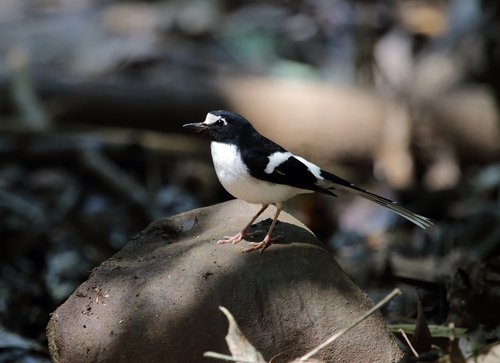
The black-backed forktail, scientifically Enicurus immaculatus (Hodgson, 1836), is a medium-sized forktail. It measures 20.5 to 23 centimetres (8+1⁄8 to 9 inches) in length and weighs 25 to 29 grams. Male wing length ranges from 8.6 to 9.8 centimetres (3+3⁄8 to 3+7⁄8 inches), while female wing length ranges from 8.6 to 9.0 centimetres (3+3⁄8 to 3+1⁄2 inches). The bill extends 2 centimetres (3⁄4 inch) from the skull, and the tail is 12.4 to 12.7 centimetres (4+7⁄8 to 5 inches) long. This species has a broad white stripe that starts just behind the eyes and runs across the forehead. The crown and mantle are entirely black, and this black feathering extends down to the upper forehead, face, scapulars, throat, and sides of the neck. Its underparts are white, with a sharp border separating them from the black throat. Both the lesser and median wing coverts are completely black, as are the bases of the greater coverts. A wide white band crosses the wing, running over the greater coverts and the bases of the inner secondary and tertiary feathers. The uppermost tertial feather is white, inner primaries have white tips, and there is a small white patch covering the base of the secondaries. All other flight feathers are black. Like most other forktails, this species has a long, graduated, deeply forked tail. The tail feathers are black with white tips, except the outermost feathers which are entirely white. The tail has a white tip and three additional white bands formed by the ends of shorter tail feathers. The beak is black, the legs and feet are whitish-pink or light flesh-coloured, and the iris is brown or dark brown. The black-backed forktail has no sexual dimorphism, and there is no known geographic variation in its appearance. Nothing is known about its moulting patterns. Juvenile black-backed forktails lack the prominent white forehead stripe. The areas that are black on adults are sooty brown or dull black in juveniles. Juveniles have a white spot behind the eye, and may have dark scaled markings or speckles on their flanks, breast, and belly. The juvenile tail is usually shorter, the lower mandible is yellowish, and the upper mandible has whitish cutting edges. This bird is similar to the slaty-backed forktail, but lacks the slaty-backed forktail's slaty back, is smaller in size, and has a slimmer bill. Compared to the similar white-crowned forktail, the white facial band is narrower, and the black-backed forktail has a white breast rather than a black one. Field identification guides note it is around the same size as bulbul species. Its call is described as a short, whistled "tseep-dew" or "hurt-zeee". The two syllables are sometimes produced separately: a hollow "huu" and a shrill "zeee", which are somewhat higher-pitched than the call of the slaty-backed forktail. It gives this two-syllable call when disturbed. It also makes a call similar to the slaty-backed forktail, which is compared to the sound of a squeaky hinge. It has been recorded occasionally producing a short song. The black-backed forktail prefers habitats near fast-flowing rivers and streams in moist tropical broadleaf forest and subtropical lowland forest. It frequents rocks and boulders in or bordering streams, as well as mud or sand banks along fast-moving stretches of water. The western end of its range is in Garhwal, in the northwestern part of the Indian state of Uttarakhand. Its range extends from there through western and central Nepal to Bhutan and the northeastern Indian states of Sikkim, Assam, Meghalaya, Arunachal Pradesh, Nagaland, and Manipur. It is a known winter visitor to Nameri National Park in Assam. It is uncommon west of Sikkim, but common in Bhutan. It is also found, uncommonly, in the Sylhet and Chittagong regions of Bangladesh. Its range extends into Myanmar (excluding the Tenasserim region) and northwestern Thailand. It has also been reported from southwestern Yunnan in China, and southeastern Tibet. BirdLife International maps its range as mostly contiguous across these regions, with the exception of an area in southern Myanmar that is separated from the main range. South Asian bird field guides describe its distribution as discontinuous. In the western part of its range, it occurs up to 1,450 metres (4,760 ft) above sea level; in the eastern part, it occurs up to 900 metres (2,950 ft) above sea level. In Nepal, its elevational range is recorded as 75 to 1,370 metres (250 to 4,500 ft) above sea level. In 1998, the species was recorded at 2,600 metres (8,500 ft) above sea level in Arunachal Pradesh's Eaglenest Wildlife Sanctuary. It breeds mostly below 600 metres (1,970 ft) in India and Bhutan. The species' population size is unknown, but it is believed to be stable and number over 10,000 individuals. Its total range area is also not precisely known, but is thought to be larger than 20,000 square kilometres. These estimates have resulted in its classification as a species of Least Concern by the International Union for Conservation of Nature. The black-backed forktail is typically solitary, or sometimes found in pairs, though family groups may be seen during the breeding season. It is described as a shy bird. It often bobs its tail while feeding, and when at rest it opens and closes its tail in a scissor-like motion. It habitually flies along the course of rivers or streams, and its flight is quick and straight, sometimes slightly undulating. It has been observed near waterfalls. The exact diet of the black-backed forktail is unknown, but it has been observed eating aquatic insects, insect larvae, and crustaceans. It usually forages along fast-moving streams and rivers, including on midstream rocks, and may occasionally enter the water. It may also forage along slower-moving rivers, ponds, or forest pools, and has been recorded foraging in damp areas of the forest. When inactive, it stays in bushes or low shrubbery. Its breeding season runs from March to June. Its nest is a cup built from plant material including dried leaves, moss, and fibres, and is sometimes lined with leaf skeletons. The nest may be placed in a dead tree hole, under a bank, on a ledge, or in a hole or cleft among rocks. Clutches usually contain three eggs, which are pinkish and sparsely speckled with fine red-brown markings. These speckles occasionally form blotches or caps at the end of the egg. Recorded eggs average 2.08 centimetres (7⁄8 in) long and 1.58 centimetres (5⁄8 in) wide. Both males and females take part in nest building and incubation. While the species is mostly sedentary, first-year birds disperse from their parental breeding areas between April and October.