About Enicognathus ferrugineus (Statius Muller, 1776)
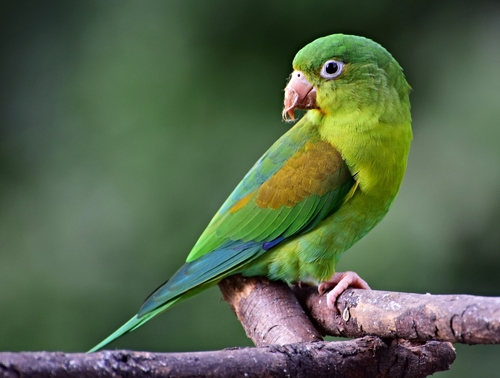
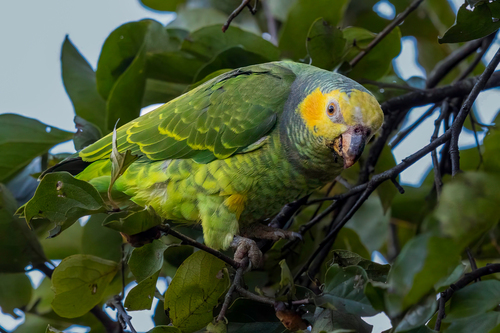
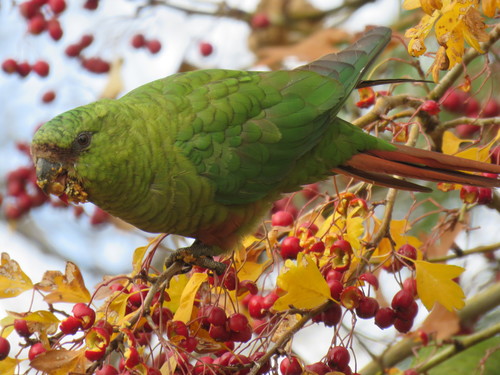
The austral parakeet, whose scientific name is Enicognathus ferrugineus (Statius Muller, 1776), measures 28 to 36 cm (11 to 14 in) in length. One recorded male specimen of the subspecies E. f. minor weighed 155 g (5.5 oz). Males and females have identical appearance. For adults of the nominate subspecies, the forehead and lores are dull reddish, while the rest of the face is yellow-green. The bird's upperparts are dull green. Its underparts are yellowish green with a dull reddish patch on the belly; dark feather edges create a scaly look. The tail is also dull reddish, and the wings are mostly green with bluish green primaries. Immature austral parakeets resemble adults, but the red markings on their face and belly are even duller. Subspecies E. f. minor is smaller and darker than the nominate subspecies. The austral parakeet is the southernmost occurring parrot species. Subspecies E. f. minor is distributed in southern Chile from the O'Higgins Region south to Aysén, and in the adjacent southwestern Argentina from Neuquén Province to northwestern Santa Cruz. The nominate subspecies occurs from the southern range limit of E. f. minor almost to Cape Horn. Undocumented sight records from the Falkland Islands lead the South American Classification Committee of the American Ornithological Society to classify the species as hypothetical there. This parakeet primarily lives in southern beech (Nothofagus) forest, and woodlands dominated by oaks (Quercus) and Drimys andina. It also lives in nearby semi-open areas, ranchlands, and occasionally occurs in cultivated areas. In the far southern part of its range, it is mostly found near sea level, while in the northern part it can be found at elevations up to 2,000 m (6,600 ft).