About Enhydra lutris (Linnaeus, 1758)
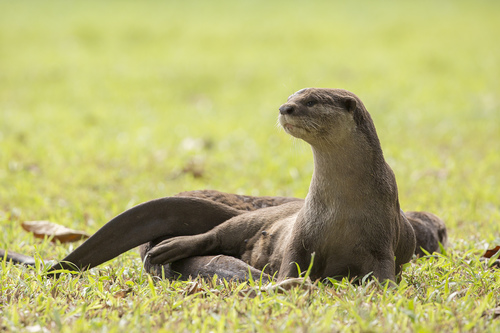
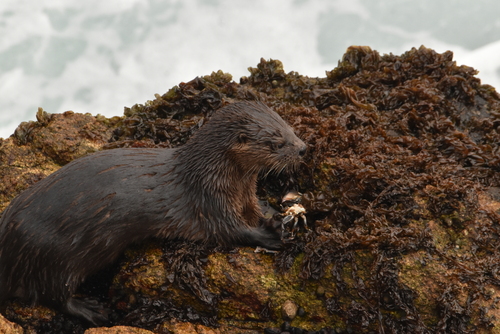
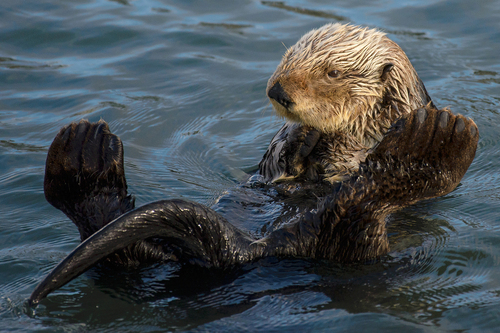
The sea otter (Enhydra lutris, first described by Linnaeus in 1758) is one of the smallest marine mammal species, and it is the heaviest mustelid. Male sea otters typically weigh 22 to 45 kg (49–99 lb) and measure 1.2 to 1.5 m (47–59 in) in length, though specimens have been recorded at up to 54 kg (119 lb). Females are smaller, weighing 14 to 33 kg (31–73 lb) and measuring 1.0 to 1.4 m (39–55 in) in length. Adult sea otters in more densely populated areas have considerably lighter average weights than those in sparser populations: average male weight is 28.3 kg (62 lb) in dense areas versus 39.3 kg (87 lb) in sparse areas, and average female weight is 21.1 kg (47 lb) in dense areas versus 25.2 kg (56 lb) in sparse areas. It is presumed that otters in less populous areas are more able to monopolize food sources. For its size, the male sea otter's baculum is very large, massive, and bent upwards, measuring 150 mm (5+7⁄8 in) long and 15 mm (9⁄16 in) at the base. Unlike most other marine mammals, the sea otter has no blubber, and relies on its exceptionally thick fur to stay warm. With up to 150,000 strands of hair per square centimetre (970,000 per square inch), its fur is the densest of any animal. The fur is made up of long, waterproof guard hairs and a short underfur; the guard hairs keep the dense underfur layer dry. An air compartment between the thick fur and the skin traps air that is heated by the body, which keeps cold water completely away from the skin and limits heat loss. A potential disadvantage of this insulation method is that the air layer compresses as the otter dives, reducing the fur's insulating quality when the animal forages at depth. The fur stays thick year-round, because it is shed and replaced gradually rather than during a distinct molting season. Since the guard hairs' ability to repel water depends on keeping the fur completely clean, the sea otter can reach and groom fur on any part of its body, thanks to its loose skin and unusually supple skeleton. Sea otter pelage is usually deep brown with silver-gray speckles, but color can range from yellowish or grayish brown to almost black. In adult individuals, the head, throat, and chest are lighter in color than the rest of the body. The sea otter has many adaptations suited to its marine environment. Its nostrils and small ears can close. The hind feet, which provide most of its propulsion when swimming, are long, broadly flattened, and fully webbed. The fifth digit on each hind foot is the longest, which makes swimming on its back easier but makes walking more difficult. The tail is fairly short, thick, slightly flattened, and muscular. The front paws are short with retractable claws, and have tough palm pads that let the otter grip slippery prey. The sea otter's bones have osteosclerosis, which increases their density to reduce buoyancy. Sea otters, which returned to the sea around 3 million years ago, offer insight into the evolutionary process of mammalian invasion of the aquatic environment, an event that has occurred many times throughout mammalian evolution. Sea otters represent a snapshot of the earliest stage of the evolutionary transition from fur to blubber. For sea otters, fur remains advantageous due to their small size and their lifestyle split between aquatic and terrestrial environments. However, as sea otters evolve and adapt to spend more of their lifetimes in the sea, convergent evolution of blubber suggests that reliance on fur for insulation would eventually be replaced by reliance on blubber. This is especially relevant given the sea otter's diving behavior: as dives become longer and deeper, the air layer in the fur becomes less effective at retaining heat and maintaining buoyancy, while blubber remains efficient at both functions. Blubber can also act as an energy source for deep dives, which would likely be advantageous over fur in sea otters' evolutionary future. The sea otter propels itself underwater by moving the rear of its body (including the tail and hind feet) up and down, and can reach speeds of up to 9 kilometres per hour (5.6 miles per hour; 2.5 metres per second). When underwater, its body is long and streamlined, with its short forelimbs pressed close against its chest. When at the water's surface, it usually floats on its back and moves by sculling its feet and tail from side to side. When resting, all four limbs can be folded against the torso to conserve heat, while on especially hot days the hind feet may be held underwater to cool the body. The sea otter's body is highly buoyant, due to its large lung capacity (about 2.5 times greater than similar-sized land mammals) and the air trapped in its fur. On land, the sea otter walks with a clumsy, rolling gait, and can run in a bounding motion. Long, highly sensitive whiskers and front paws help the sea otter locate prey by touch when waters are dark or murky. Researchers have observed that when researchers approach sea otters in plain view, the animals react more rapidly when wind blows toward them from the researchers, indicating that the sense of smell is more important than sight as a warning sense. Other observations show that the sea otter's sense of sight is effective both above and below water, though it is not as good as that of seals. Its hearing is neither particularly acute nor poor. An adult sea otter has 32 teeth; its molars in particular are flattened and rounded to crush food rather than cut it. Seals and sea otters are the only carnivores that have two pairs of lower incisor teeth instead of three; the adult dental formula is 3.1.3.1 / 2.1.3.2. The sea otter's teeth and bones are sometimes stained purple from ingesting sea urchins. The sea otter has a metabolic rate two or three times that of similarly sized terrestrial mammals. It must eat an estimated 25 to 38% of its own body weight in food each day to get the calories needed to counteract heat loss in the cold water environment. Its digestive efficiency is estimated at 80 to 85%, and food can be digested and passed in as little as three hours. Most of the sea otter's water requirement is met through the food it eats, but unlike most other marine mammals, it also drinks seawater. Its relatively large kidneys allow it to extract fresh water from seawater and excrete concentrated urine. Sea otters inhabit coastal waters 15 to 23 metres (49–75 ft) deep, and usually stay within 1 kilometre (2⁄3 mile) of shore. They are most often found in areas protected from the most severe ocean winds, such as rocky coastlines, thick kelp forests, and barrier reefs. Although they are most strongly associated with rocky substrates, sea otters can also live in areas where the sea floor is primarily made up of mud, sand, or silt. Their northern range is limited by ice: sea otters can survive among drift ice but cannot survive in areas with land-fast ice. Individual sea otters generally occupy a home range a few kilometres long and remain there year-round. The sea otter population is thought to once have numbered 150,000 to 300,000, with a range spanning an arc across the North Pacific from northern Japan to the central Baja California Peninsula in Mexico. The fur trade that began in the 1740s reduced sea otter numbers to an estimated 1,000 to 2,000 individuals across 13 colonies. Hunting records researched by historian Adele Ogden place the westernmost limit of historical hunting grounds off the northern Japanese island of Hokkaido, and the easternmost limit off Punta Morro Hermosa, about 34.6 kilometres (21+1⁄2 miles) south of Punta Eugenia, Baja California's westernmost headland in Mexico. Today, the species is recovering to varying degrees across about two-thirds of its former range, with high population densities in some areas and threatened populations in others. Sea otters currently have stable populations in parts of the Russian east coast, Alaska, British Columbia, Washington, and California, with reports of recolonization in Mexico and Japan. Population estimates made between 2004 and 2007 put the current worldwide total at approximately 107,000 sea otters. However, much more recent counts of sea otter populations in areas such as the Aleutian Islands in Alaska and the Sea of Okhotsk along Russia's coast have shown steep declines in recent years, which casts doubt on these earlier estimates. Sea otters are polygynous: males have multiple female partners, typically those that live within their territory. If a male has not established a territory, he seeks out females that are in estrus. When a male sea otter finds a receptive female, the two engage in playful and sometimes aggressive behavior. They stay bonded for the duration of estrus, which lasts 3 days. During copulation, the male holds the female's head or nose with his jaws. Visible scars are often present on females from this behavior, and in severe cases trauma to the face or nose can kill the female. Births occur year-round, with peaks between May and June in northern populations and between January and March in southern populations. Gestation length varies from four to twelve months, because the species is capable of delayed implantation followed by four months of active pregnancy. In California, sea otters usually breed every year, about twice as often as Alaska sea otters. Birth usually takes place in the water and most often produces a single pup that weighs 1.4 to 2.3 kilograms (3 lb 1 oz to 5 lb 1 oz). Twins occur in 2% of births, but usually only one pup survives. At birth, pups have open eyes, ten visible teeth, and a thick coat of baby fur. Mothers have been observed licking and fluffing newborn pups for hours; after grooming, the pup's fur traps so much air that the pup floats like a cork and cannot dive. The fluffy baby fur is replaced by adult fur after roughly 13 weeks. Nursing lasts six to eight months in Californian populations and four to twelve months in Alaskan populations, and the mother starts offering bits of prey to the pup when it is one to two months old. The milk from a sea otter's two abdominal nipples is high in fat, and is more similar to the milk of other marine mammals than to the milk of other mustelids. With guidance from its mother, a pup practices swimming and diving for several weeks before it can reach the sea floor. Initially, the objects the pup retrieves are of little food value, such as brightly colored starfish and pebbles. Juveniles are typically independent at six to eight months, but a mother may be forced to abandon a pup if she cannot find enough food to support it; at the other extreme, a pup may be nursed until it is almost adult size. Pup mortality is high, especially during an individual's first winter: one estimate finds that only 25% of pups survive their first year. Pups born to experienced mothers have the highest survival rates. Females perform all tasks of feeding and raising offspring, and have occasionally been observed caring for orphaned pups. Sea otter mothers are widely noted for their devotion to their pups: a mother gives her infant almost constant attention, cradles it on her chest out of the cold water, and grooms its fur attentively. When foraging, she leaves her pup floating on the water, sometimes wrapped in kelp to stop it from floating away; if the pup is not sleeping, it cries loudly until she returns. Mothers have been recorded carrying their pups for days after the pups have died. Females become sexually mature at around three or four years of age, and males at around five years of age; however, males often do not successfully breed until a few years after reaching maturity. A captive male has sired offspring at age 19. In the wild, sea otters live to a maximum age of 23 years, with average lifespans of 10 to 15 years for males and 15 to 20 years for females. Several captive individuals have lived past 20 years. The Seattle Aquarium held both the oldest recorded female sea otter, Etika, who lived to age 28, and the oldest recorded male, Adaa, who lived to 22 years 8 months. Sea otters in the wild often develop worn teeth, which may explain their apparently shorter lifespans.