About Enhalus acoroides (L.f.) Royle
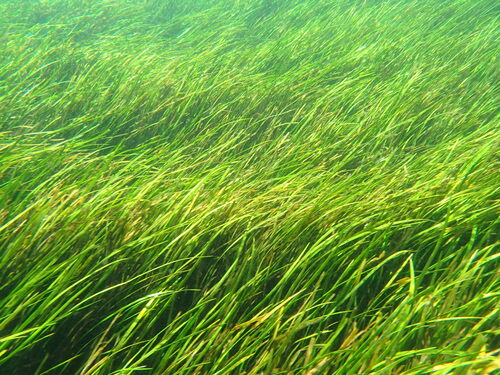
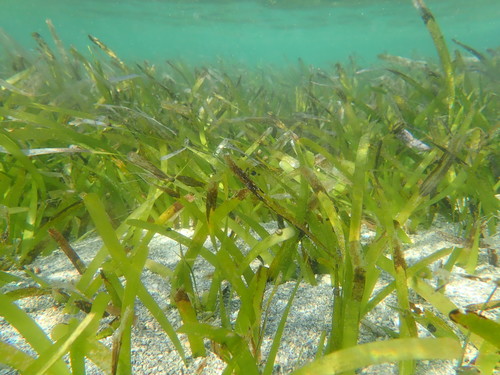
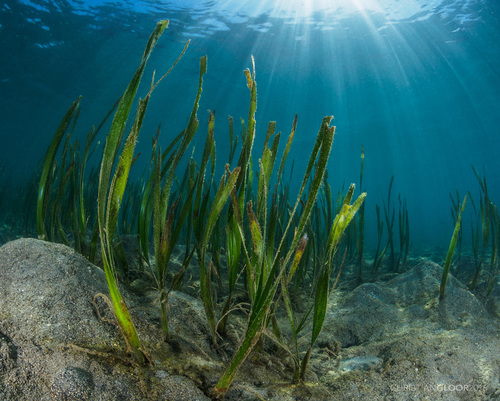
Enhalus acoroides has massive rhizomes 1.5 cm in diameter that anchor the plant in soft mud substrates, letting it withstand wave action and tidal currents. It produces long, strap-like leaves 30 to 150 cm long. These leaves make up a significant proportion of the total plant biomass in shallow water seagrass beds. Due to their large size and position in the water column, they provide extensive surface area for epibiont organisms to live on. The plant produces round, large fruit 4 to 6 cm in diameter, with dark, ribbed skin and 6 to 7 white seeds.
Male Enhalus acoroides plants bear a single pedunculate inflorescence that holds clusters of highly reduced flowers, each of which forms a small free-floating structure. Female plants bear only a single inflorescence, but the peduncle of the female flower is much longer.
Enhalus acoroides is a littoral species that grows in shallow soft substrates, including muddy or sandy flats and coral substrates, depending on its growing region. Its range extends from the Red Sea south to northern Mozambique in the Indian Ocean, and as far east as Papua New Guinea. It grows in mixed seagrass meadows, where it can make up 90% of the meadow's biomass, most often alongside Thallassia hemprichii. It can also grow in isolated patches. It grows best just above the level of mean low water springs, and generally grows to depths of up to 4 meters.
This species is dioecious, and is capable of both sexual and asexual reproduction. Through spreading lateral rhizomes, it forms small isolated patches that contain 25 to 200 shoots. Like other seagrasses it produces pollen, but it is unique as the only seagrass species that practices surface pollination. During this process, the male flower breaks off from the spathe and rises to the water surface, where its hydrophobic inflorescence holds numerous flowers. Once at the surface, the male flower releases its pollen to a female inflorescence that has reached the water surface via its elongated stalk. The developing fruit is pulled under water to complete ripening. Flowering occurs year round, and the number of flowers produced is strongly tied to variations in mean water temperature.