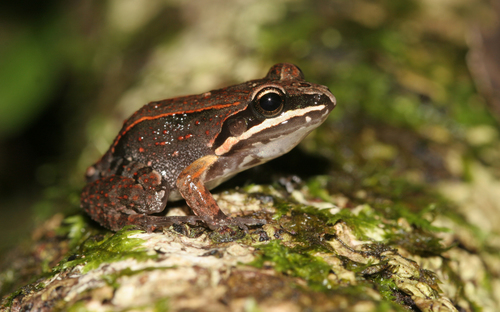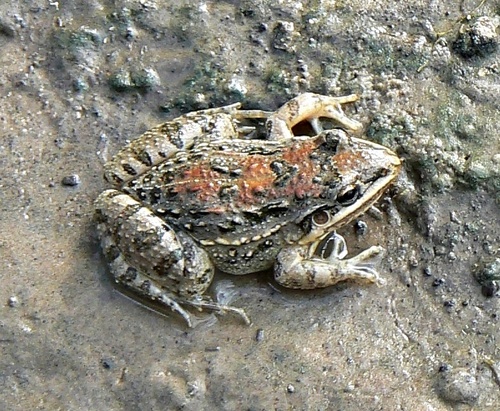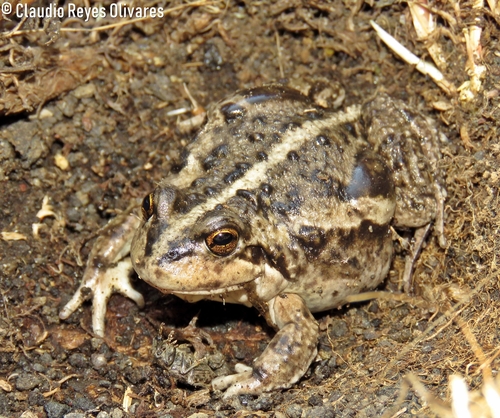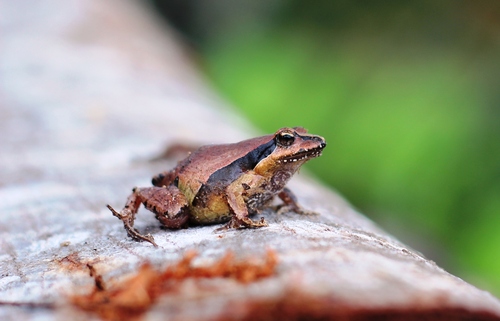
About Engystomops pustulosus (Cope, 1864)
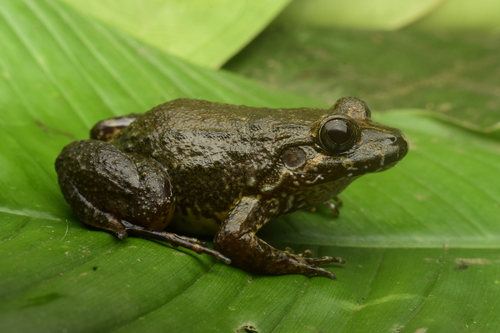
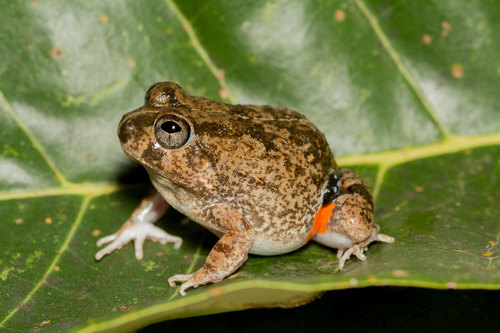
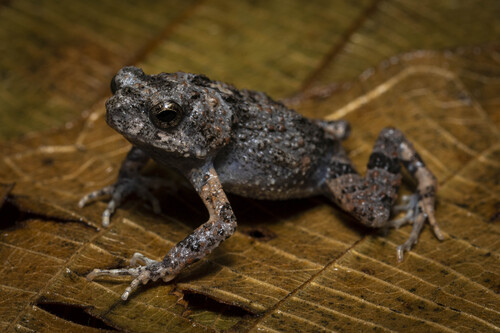
Engystomops pustulosus, commonly known as the túngara frog, is a small species of terrestrial frog that reaches an adult length between 25 and 35 mm (1.0 and 1.4 in). Its tympanum is not visible, and its back (dorsum) is covered in small warts. Because of these warts, early descriptions incorrectly classified túngara frogs as a toad species in the Bufo genus. This frog has relatively large, protruding eyes. Males have large, dark vocal sacs that expand when they call to attract females. Both males and females typically have a noticeable white stripe that runs from the lower lip down the throat. This species is found from Mexico, through all of Central America, and into northern South America, reaching as far east as Trinidad and Tobago and Venezuela; its range may also extend into Guyana. Its natural habitats include subtropical or tropical dry forest, dry savanna, moist savanna, subtropical or tropical dry lowland grassland, subtropical or tropical seasonally wet or flooded lowland grassland, freshwater marshes, intermittent freshwater marshes, pastureland, heavily degraded former forest, ponds, and canals and ditches. Engystomops pustulosus is nocturnal. It emerges at night to forage for ants, termites, and other small invertebrates including snails, beetles, flies, and isopods among plant litter on the ground. During the breeding season, males gather at night in temporary pools and call to attract mates. When a female selects a male, amplexus occurs at the edge of the water, and the male creates a foam nest where eggs are laid. Tadpoles develop in the water and complete metamorphosis into juvenile frogs in approximately four weeks. When breeding, male túngara frogs gather in choruses at breeding sites and call to attract mates. Females move easily through the group of males and choose their mate through physical contact. The male clasps the female from above, and this amplexus position can last for up to several hours. During mating, the male positions himself centered atop the female and rhythmically mixes a foam-producing secretion released by the female to create a floating foam nest. These nests are made of a sturdy bio-foam that protects fertilized eggs. Tadpoles leave the nest after approximately four days, after which the nest breaks down; if unused, the nest can last for up to two weeks. Female túngara frogs also perform elicitation behaviors, which primarily act to cause a potential mate to increase the intensity of his sexual display. Among the repeatable, observable locomotor behaviors females display, behaviors where females clearly move closer to or farther from males are called approach/retreat (AR) behaviors. Behaviors where females do not move closer or farther are called nonapproach/retreat (NAR) behaviors. Elicitation behaviors specifically are NAR behaviors that trigger males to produce a greater number of chucks. Their primary function is to manipulate male displays, not to select a mate. Elicitation behaviors change in frequency based on male chorus size: they are more common in low-density choruses than in high-density choruses, because their main purpose is to trigger an increase in chuck production. In high-density choruses, increased chuck production does not provide as much benefit as it does in low-density choruses.