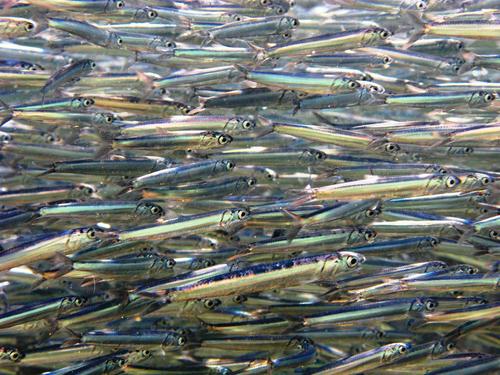
About Engraulis encrasicolus (Linnaeus, 1758)
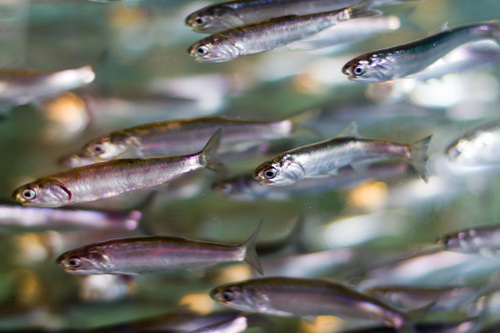
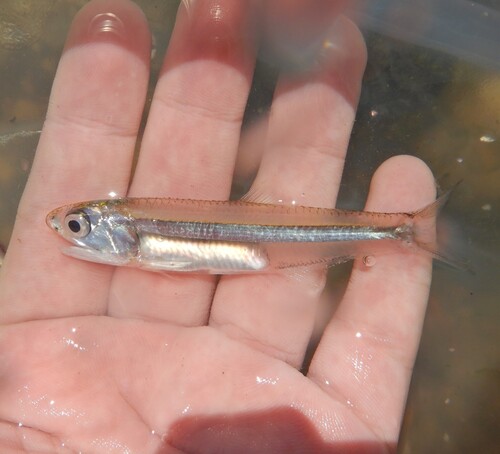
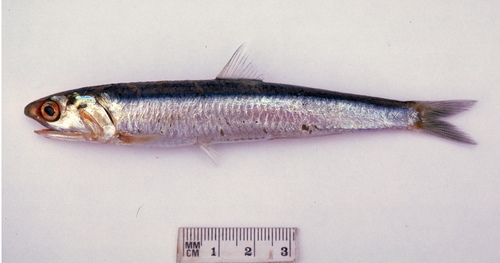
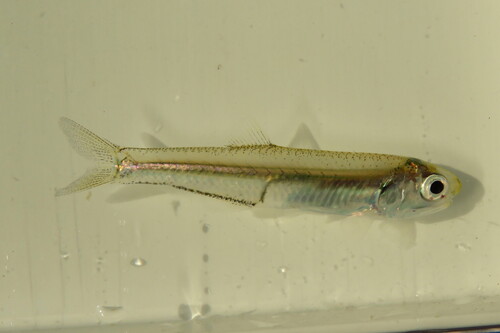
Engraulis encrasicolus, the European anchovy, can be easily recognized by its deeply cleft mouth, where the angle of the gape sits behind the eyes. Its pointed snout extends past the lower jaw. Like sprats, this fish has a forked tail and a single dorsal fin, but its body is round and slender. The maximum recorded weight for an individual European anchovy is 49 g (1.7 oz), while the maximum recorded length is 21 cm (8+1⁄8 in); a more typical adult length is 13.5 cm (5.3 in). It has a silver underbelly, with blue, green, or grey coloring on its back and sides. A silver stripe runs along its side, which fades as the fish ages. The European anchovy is a coastal pelagic species. In summer, it typically inhabits water less than 50 m deep, though in the Mediterranean it moves to depths of 200 m during winter, and can go as deep as 400 m overall. As an euryhaline species, it can survive in water with a salinity ranging from 5 to 41 PSU (standard sea water salinity is around 35 PSU), so it can live in brackish water in lagoons, estuaries, and lakes. European anchovies feed on plankton, mostly copepods, and the eggs and larvae of fish, molluscs, and cirripedes. They are migratory, usually traveling north in summer and south in winter. They form large schools, and may create bait balls when threatened. Many species of fish, birds, and marine mammals prey on European anchovies. This species spawns multiple times during warm periods from approximately April to November, with timing depending on when water temperatures are warm enough. At least some local subpopulations have separate spawning grounds, making them genetically distinct, though spawning grounds can shift. Some spawning even occurs in fresh water. The eggs of the European anchovy are ellipsoidal to oval in shape. They float as plankton in the upper 50 m of the water column for 24 to 65 hours before hatching. Newly hatched larvae are transparent and grow quickly; if a larva survives its first year, it will typically reach 9–10 cm (3.5–3.9 in) long. Females grow larger than males. Anchovies spawn for the first time when they reach a length of 12–13 cm (4.7–5.1 in). A survey of southwestern African populations found no specimens older than three years of age. European anchovies are widely used as food. They are classified as an oily fish with a salty, strong flavor, and some people eat them raw. They are sold fresh, dried, smoked, salted, in oil, frozen, and canned, and also processed into fishmeal and fish oil. Their good preservation properties have made them a traditional product for long-distance trade. They are also used as bait for fishing.