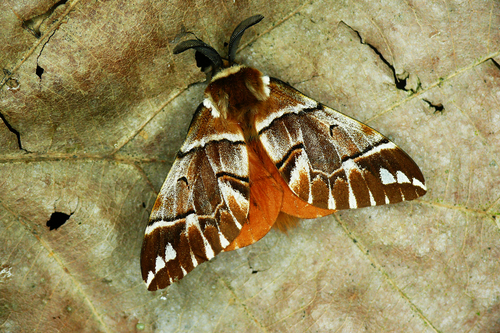
About Endromis versicolora (Linnaeus, 1758)
Endromis is a monotypic moth genus in the family Endromidae, first erected by Ferdinand Ochsenheimer in 1810. Its only known species is Endromis versicolora, commonly called the Kentish glory, which was originally described by Carl Linnaeus in the 10th edition of Systema Naturae, published in 1758. This species is distributed across the Palaearctic region. The wingspan of adult Kentish glories ranges from 50 to 70 mm. Adults fly between March and May. Females are significantly larger and paler than males, and only fly at night when they go to lay eggs. Males fly both during the day and night, and can detect female pheromones from distances of up to 2 kilometers. Eggs are yellow when first laid, and turn purplish-brown as they develop; they are laid in two or three rows around a thin birch branch. Small black caterpillars hatch from the eggs after 10 to 14 days. Caterpillars feed primarily on birch, which are species in the genus Betula, but will also feed on other trees and shrubs including Alnus, Corylus, Tilia and Carpinus species. Mature caterpillars are green with paler stripes. Young caterpillars feed in small groups of 15 to 30 larvae, while mature caterpillars feed alone and only feed at night. Endromis versicolora produces one generation per year. It overwinters as a pupa inside a thin, loose but strong cocoon that is buried shallowly in soil. The Kentish glory is mainly found in open birch woodlands, forest edges, and clear-felled areas. Within the United Kingdom, the species is restricted to just a few populations in Scotland, and it is included on the Scottish Biodiversity List as a species of principal conservation importance.

