About Endiandra discolor Benth.
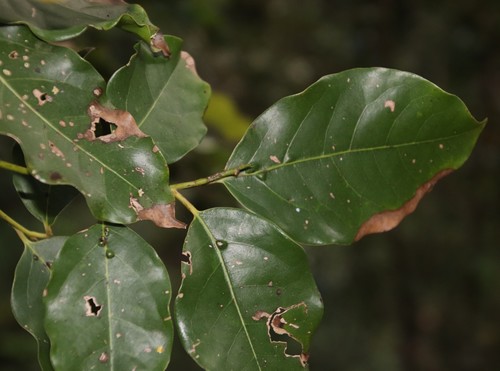
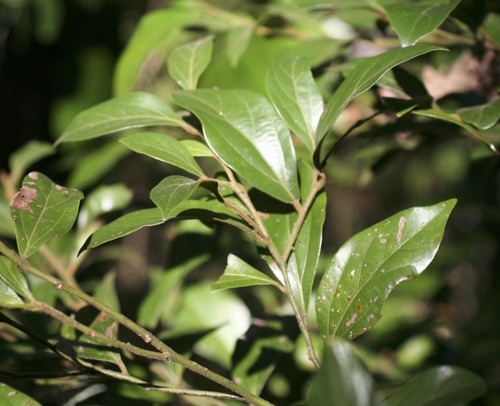
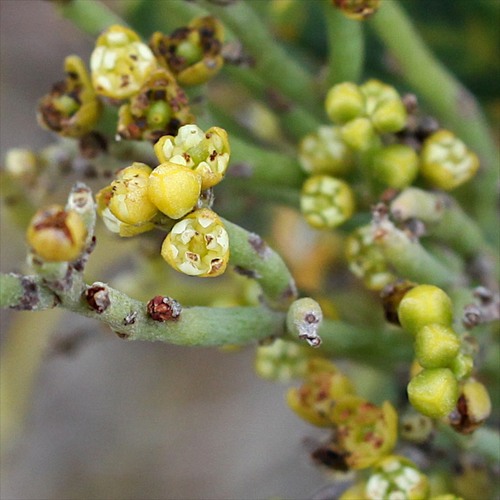
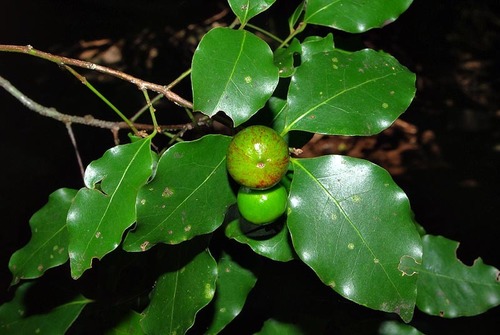
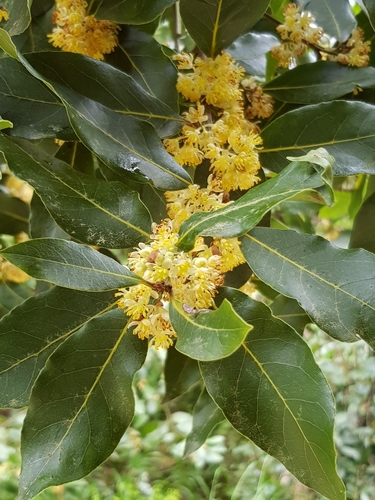
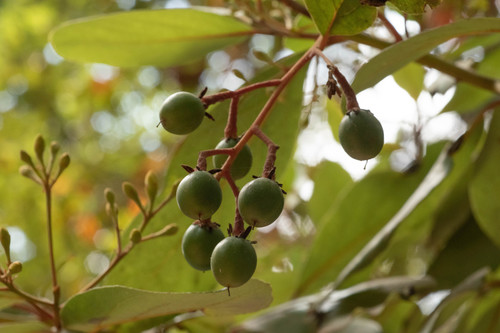
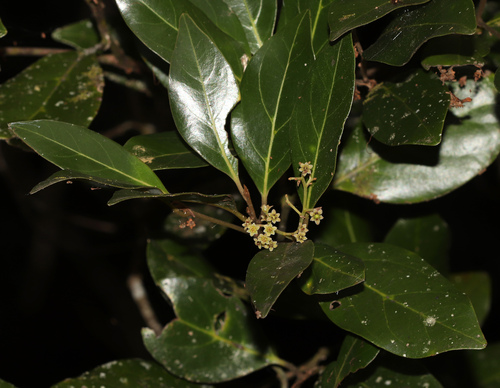
Endiandra discolor Benth. is a tree that reaches up to 25 meters (82 feet) tall, and very frequently develops buttresses. Its bark is brown or brownish grey; it is smooth on young trees, while the bark of older trees is rougher, marked by small depressions that are sometimes inhabited by insects. Twigs and new shoots are covered in fine pale brown to white hairs, and twigs have a fluted shape. Leaves are simple, arranged alternately along the twigs, and grow to a maximum of 10 cm (3.9 in) long and 5 cm (2.0 in) wide. Leaves are hairless on their upper surface, and dull grey-green to white on their lower surface. They are attached to twigs by a petiole (leaf stalk) that reaches up to 10 mm (0.4 in) long. Leaves have an elliptic to ovate shape, with 3 to 7 lateral veins on each side of the midrib, and conspicuous foveoles at the junction of each lateral vein with the midrib. Inflorescences are panicles that grow from leaf axils, and are either shorter than or equal in length to the leaves. The small, scented, creamy green flowers are covered in fine hairs, and measure approximately 2 mm (0.1 in) long and 5 mm (0.2 in) wide, with three inner and three outer tepals. The fruit is a shiny black drupe, around 17 mm (0.7 in) long and 13 mm (0.5 in) wide, containing a single brown seed that is roughly 14 mm (0.6 in) long by 9 mm (0.4 in) wide. The thin fruit flesh is green, and the interior of a cut seed is cream to pink. Like many Australian laurel species, the seed is slightly ribbed. In its ecology, the fruit of Endiandra discolor is eaten by many rainforest birds, including the wompoo fruit dove, catbird, rose crowned fruit dove, superb fruit-dove, and topknot pigeon. Its leaves serve as a food source for the larvae of the Macleay's swallowtail butterfly (Graphium macleayanum). This plant also acts as a larval host for the fruit fly Bactrocera endiandrae.