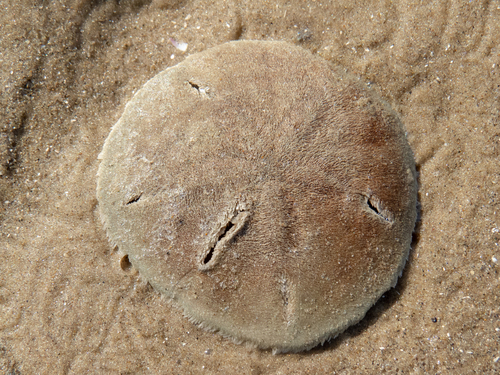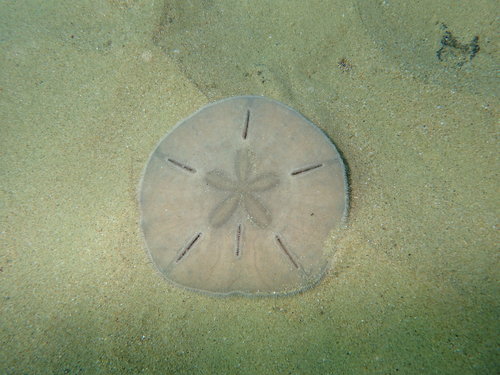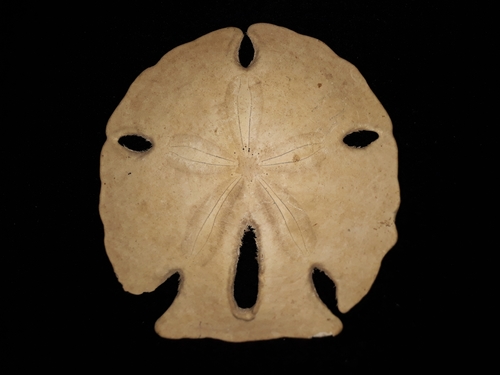
About Encope emarginata (Leske, 1778)
Encope emarginata (Leske, 1778) has a thick test (shell) that often stays intact when preserved. Its tests are oval-shaped, centrally domed, and typically greenish-brown. This species has 6 lunules (notches) and large bowed petaloids. Young E. emarginata can be mistaken for its close relative E. michelini, because juveniles have open lunules, while the lunules are closed in adults. Encope emarginata is mostly found in subtropical and tropical waters of the Caribbean Sea, Gulf of Mexico, and southwestern Atlantic Ocean, ranging from Belize to Argentina. It is common on the Atlantic coastline of South America; it is one of only two extant echinoids found on the coast of Rio Grande do Sul (the other being Mellita quinquiesperforata), and the only extant echinoid found south of the La Plata river. The area occupied by Encope emarginata lies below the reach of normal wave action, so fossils of this species are only significantly disturbed during extreme coastal weather. Encope emarginata lives in sandy, muddy sediments of coastal waters. Though it is a marine species, it has also been found in estuaries and river mouths. It typically inhabits shallow waters, up to 20 meters deep.