About Encephalartos ghellinckii Lem.
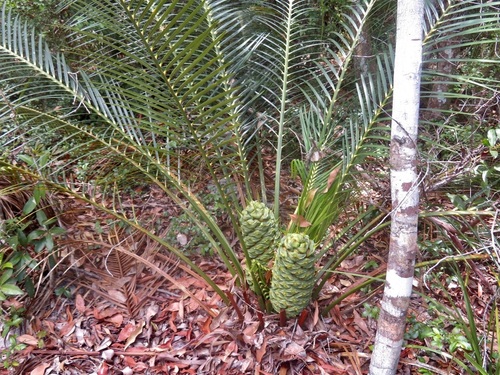
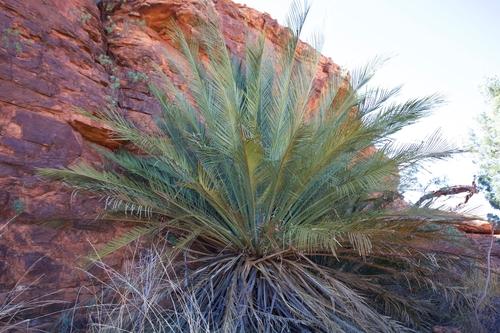
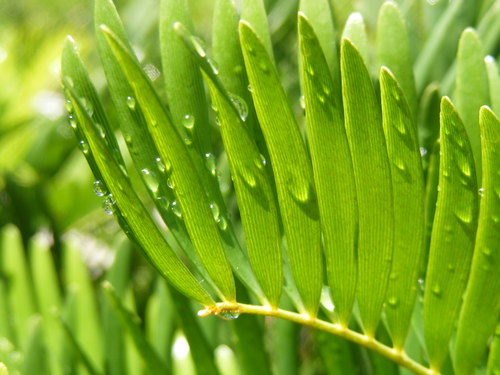
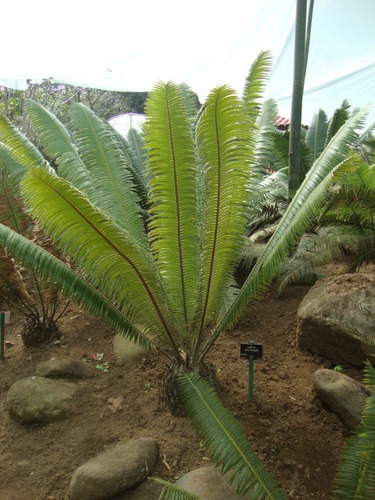
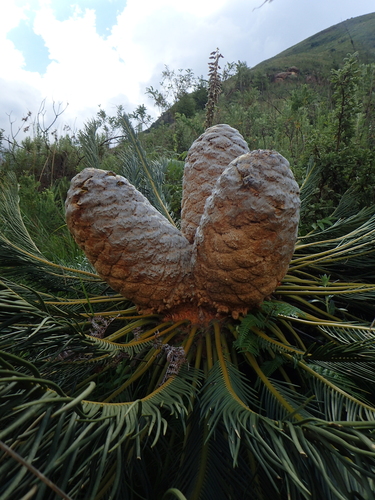
Encephalartos ghellinckii Lem. has olive to yellow-green fronds that are around 1 meter long. Its leaflets are narrow, measuring 80–140 by 2–4 mm, with strongly revolute margins. Juvenile leaves are covered in greyish wool, and become glabrous as they age. Both male and female lemon-coloured cones grow to around 25 cm in length, appear in clusters of 2 to 5, and are densely woolly. While this species was originally thought to be wind-pollinated, recent studies show its cones are mainly pollinated by weevils and Boganiidae beetles, such as Metacucujus encephalarti. Boganiidae beetles are only known from South Africa and Australia, and this shared distribution with the cycad family points to an ancient association between these insects and cycads. The beetles are strongly attracted to allomones produced by both male and female cones in the early mornings and evenings. The seeds have a yellow, fleshy covering. The seeds are poisonous, containing the azoxyglycosides macrozamin and cycasin; these toxins are also present in smaller concentrations in the seed flesh, roots, stems and leaves. These toxins are characteristic of and unique to cycads, and play an important role in deterring herbivores. This species is named for Édouard de Ghellinck de Walle, a 19th-century Ghent plant collector, horticulturist and amateur botanist who first cultivated it in Europe. It was formally described in 1868 by Charles Antoine Lemaire, a French taxonomist who was an authority on Cactaceae. Although it grows slowly in cultivation, increasing exploitation, especially of its dwarf form, has caused a sharp decline in population and local extirpation in some areas, making urgent conservation measures necessary. This cycad is found in three distinct, separate areas in KwaZulu-Natal and northern Transkei. Plants from high-elevation areas are more robust and typically have a fire-scarred base. Low-elevation plants, such as those growing near the Umkomaas River, are stunted or dwarf-like, and may grow up to five trunks, often blackened by grass fires; these fires are thought to stimulate leaf and cone production. Plants growing in tall grassveld are usually spindly with tall stems, and tend to lean, often becoming quite procumbent.