About Encephalartos ferox G.Bertol
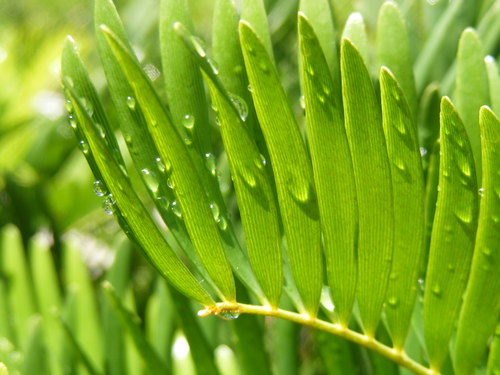
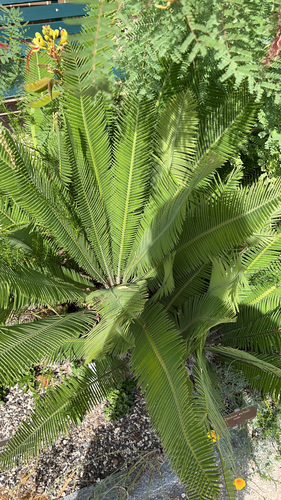
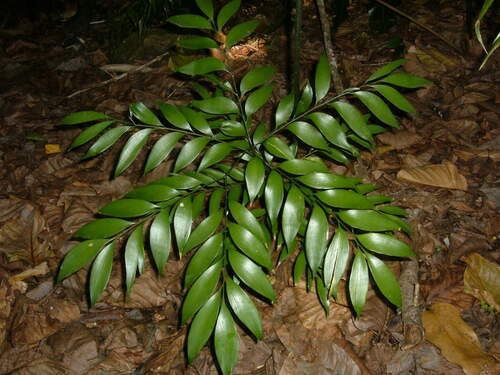
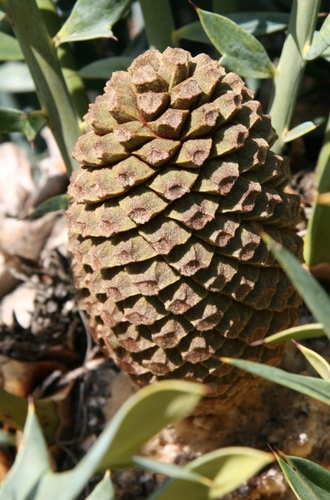
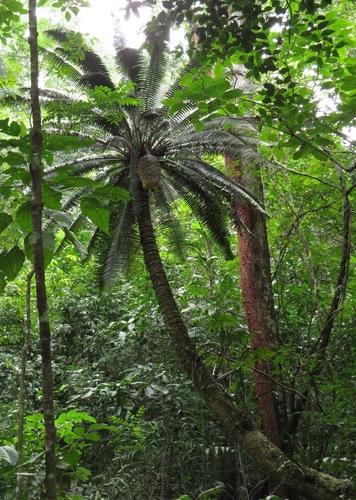
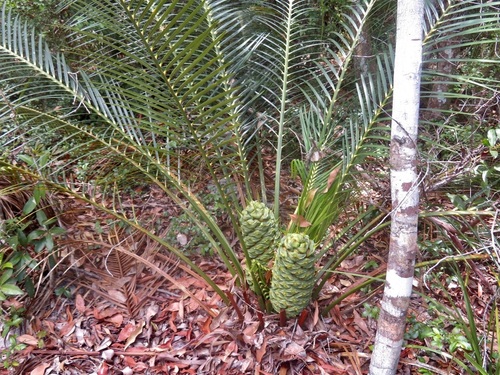
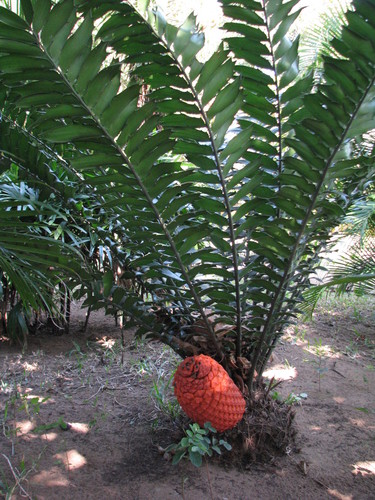
Leaf, stem, and root morphology: The trunk of Encephalartos ferox G.Bertol is often subterranean, and can reach up to one meter in length. Its roots contract due to the collapse of transverse sheets of cells in the cortex; this contraction is thought to help prevent seedling desiccation during development. The leaves are pinnately compound, growing up to two meters long. They are typically hard-textured and green, while young leaves are hairy, and range in color from dark green to coppery brown. Each leaflet measures around 15 cm long and 3.5 to 5 cm wide. Leaflets may be flat or twisted, are usually broad with spine-tipped lobes, and attach to the rhachis at an angle of approximately 70°. Habitat: E. ferox occurs along the southern coast of Mozambique and in northern Natal. It grows very close to the ocean in white beach sand, often alongside other vegetation on sand dunes, and can also be found in evergreen forests. Its preferred habitat is very humid in summer, with annual rainfall between 1,000 mm and 1,250 mm. Winters in this region are mild, and it is unknown whether this species is ever exposed to frost. Reproduction and growth: E. ferox grows relatively quickly compared to species in other cycad genera, but is considered slow-growing when compared to plants from other orders and classes. It reproduces via cones that are dark salmon in color, which differs from the greenish cones typical of most other cycads. Only E. gratus shares this cone color, though the two species likely evolved this trait independently. The cones are sexually dimorphic: male cones are cylindrical, 40 to 50 cm long, 7 to 10 cm wide, and have a peduncle 2 to 3 cm long; female cones are 25 to 50 cm long, 20 to 25 cm wide, and are sessile. A single male plant can produce up to ten cones at once, while a single female plant can produce up to five cones. Cones emerge in succession, rather than all at the same time. The megasporophyll shields are pyramidal with flattened facets. The seeds are red, narrow, oblong, and glossy, measuring 4.5 to 5 cm long and 1.5 to 2 cm wide. Human use and cultivation: E. ferox is very popular in cultivation, since it grows fairly easily when provided with plenty of water, well-drained soil, and moderate temperatures. It has low frost tolerance, so it is best suited for warmer regions. It can be propagated both from seed and by removing suckers. Local people harvest and consume starch from the stem of E. ferox.