About Enarmonia formosana (Scopoli, 1763)
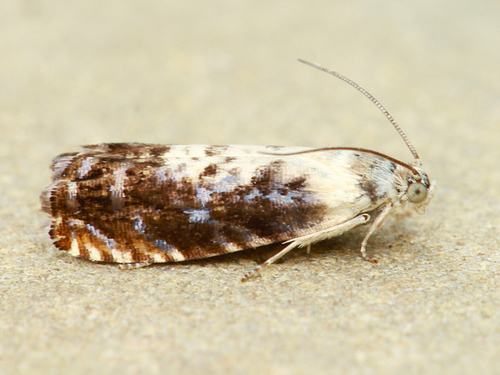
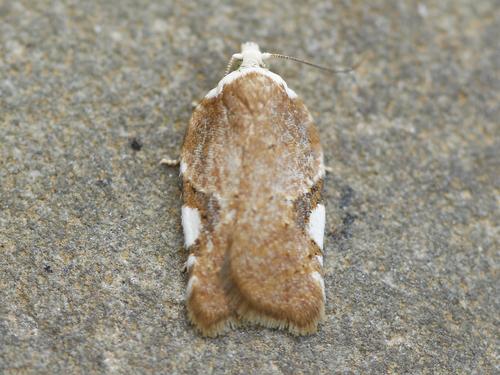
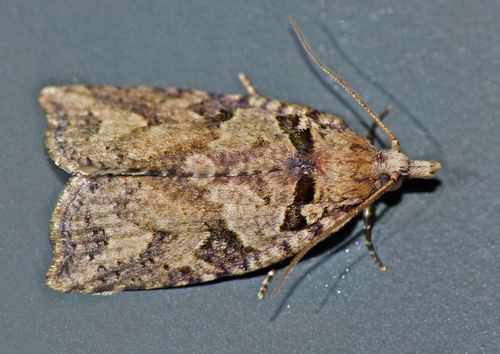
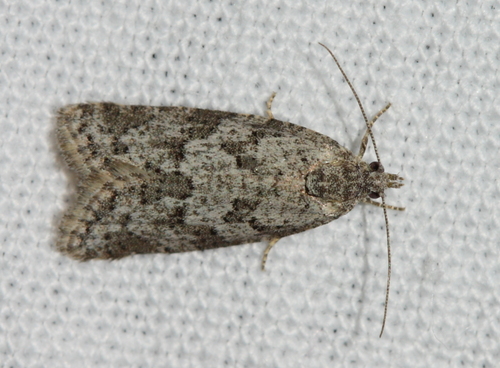
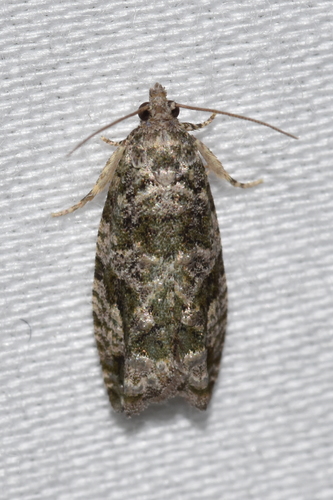
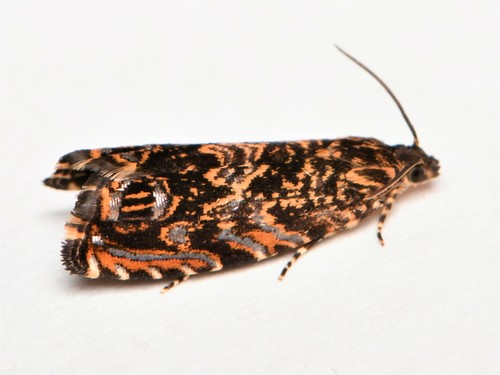
Enarmonia formosana has a wingspan of 15 to 19 millimeters. Its forewings have a moderately arched costa. The forewing ground color is ferruginous-ochreous, marked with leaden metallic striae. The costa is blackish, and posteriorly strigulated with white. The edge of the basal patch is sharply angulated in the middle and indented near the dorsum. The central fascia is dark fuscous, interrupted in the middle, and marked with ferruginous-ochreous. The ocellus is black, edged with leaden-metallic, streaked with ferruginous, and surmounted by a dark fuscous curved mark. The hindwings are a rather dark fuscous. The larvae are rosy-whitish. In the temperate parts of this species' range, such as Belgium and the Netherlands, adult moths fly from May to October. Caterpillars of Enarmonia formosana feed on the bark of woody Rosaceae in the subfamily Amygdaloideae: specifically hawthorns (Crataegus), apples (Malus), cherries (Prunus), and pears (Pyrus). They have been specifically recorded foraging at canker lesions. These larvae prefer mature trees, and produce reddish frass at the entrance to their tunnel. Signs of larval feeding appear at bark cracks or at joints connecting to branches. Larvae pupate at the entrance to their tunnel, often enclosed by frass held together with silk. This species is native to most of Europe. Its native range extends east through Asia to Siberia and Kazakhstan, and south to Maghreb in North Africa. Populations found in Asia Minor and North America are possibly, and most likely, introduced.