About Emys blandingii (Holbrook, 1838)
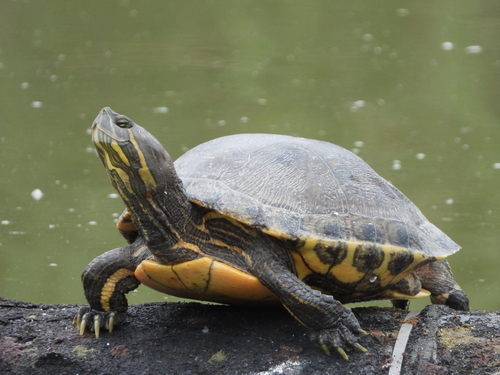
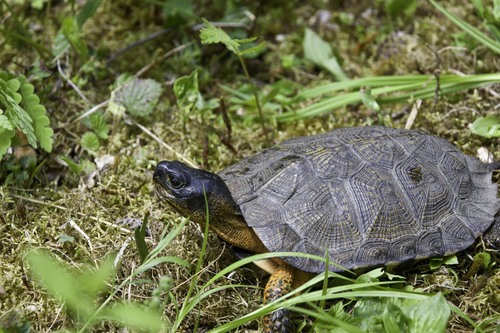
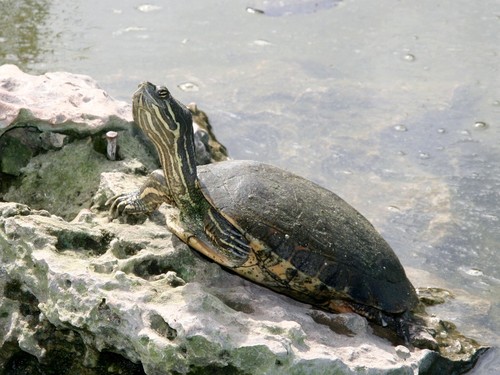
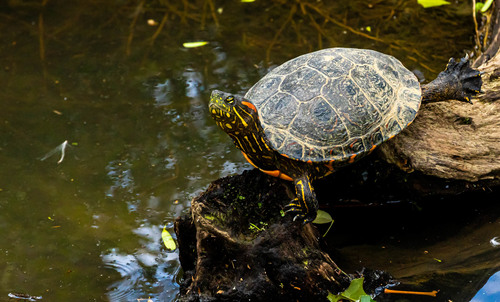
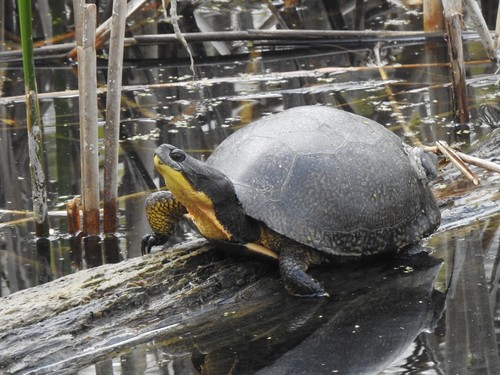
Blanding's turtle (Emys blandingii (Holbrook, 1838)) is a medium-sized turtle, with an average straight carapace (upper shell) length of 18 to 23 cm (7.1 to 9.1 in) and a maximum length of 25.5 cm (10.0 in). A key distinguishing feature of this species is its bright yellow chin and throat. The domed carapace is slightly flattened along its midline, oblong when viewed from above, and covered in numerous yellow or light-colored flecks or streaks over a dark background. The plastron (lower shell) is yellow with symmetrically arranged dark blotches. It has dark head and legs that are usually speckled or mottled with yellow. This species is sometimes called the "semi-box" turtle: while its plastron is hinged, the plastral lobes do not close as tightly as those of true box turtles. The geographic range of Emys blandingii is centered around the Great Lakes. It extends from central Nebraska and Minnesota, where it twice failed to gain designation as the state reptile, eastward through southern Ontario and the south shore of Lake Erie as far east as northern New York. In Nebraska, the species is uncommon in the eastern part of the state, but common to abundant in lakes, ponds, and streams of the Sand Hills region. Isolated populations also exist in southeastern New York's Dutchess County, New England, and Nova Scotia. Blanding's turtle generally inhabits clean shallow-water wetlands. It basks on logs, and will wander far from water, especially when nesting. It typically nests in sunny areas with well-drained soil. Younger turtles may bask on sedge and alder hummocks, and both young and older turtles will often travel long distances to find mating sites, new habitat, or new food sources. Blanding's turtle reaches sexual maturity between 14 and 20 years after hatching. Mating begins between March and April, and females dig nests from late May into early July. Clutch size varies by region: in New York, clutch size ranges from five to twelve eggs, with an average of eight. Hatchling sex is determined by egg temperature during development: colder temperatures produce males, while warmer temperatures produce females.