About Emydocephalus annulatus Krefft, 1869
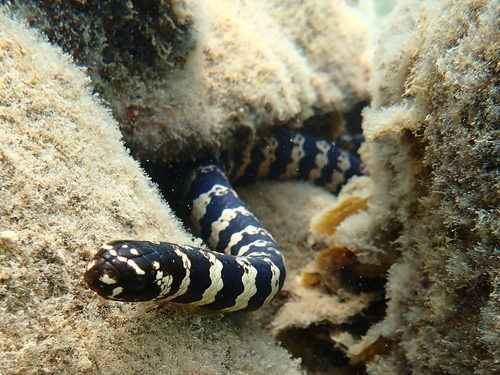
Emydocephalus annulatus Krefft, 1869 is a medium-sized snake named for its short, blunt head, and it has a slender build with variable coloration. A single individual can be entirely one solid color, or it can have banded patterning made up of white or yellow with dark rings. The scales on the top of the head are large, regularly shaped, and entire. The rostral scale at the tip of the snout is conical, and the second of the three supralabial scales is the largest of these. The snake's body has 15 to 17 rows of smooth, overlapping scales. It has 125 to 145 ventral scales, a single anal scale, and 20 to 33 single subcaudal scales. This species can grow up to 103 cm (41 in) in length. An individual snake's color influences how much algal fouling accumulates on its body. Darker, more uniformly colored snakes develop higher levels of algal build-up than paler, patterned snakes of the same species. The extra weight of accumulated algae reduces the snake's movement speed by up to 20%. Snakes with impaired locomotion tend to be less active and hide among coral, while snakes with little to no algal fouling are actively foraging. This difference in activity level does not impact survival rates; lighter-colored snakes are no more likely to survive than darker-colored individuals.