About Empidonomus aurantioatrocristatus (Orbigny & Lafresnaye, 1837)
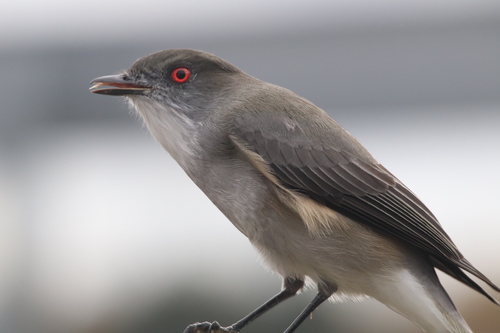
The crowned slaty flycatcher (scientific name Empidonomus aurantioatrocristatus (Orbigny & Lafresnaye, 1837)) measures 16.5 to 18 cm (6.5 to 7.1 in) in length and weighs 27 to 46 g (0.95 to 1.6 oz). Males and females have identical plumage. Adults of the nominate subspecies have a flattened black crown with a mostly hidden central golden yellow patch, a gray supercilium, and dusky ear coverts. Their upperparts are brownish gray, their wings and tail are dusky with lighter feather edges, and their underparts are light gray with a yellowish tinge on the belly. Subspecies E. a. pallideventris is smaller than the nominate subspecies, with much lighter pale grayish olive upperparts and lighter mouse-gray underparts. Juveniles have a paler, more contrasting supercilium than adults, with white edges on the wing coverts and flight feathers, and thin rufous edges on the tail feathers. Both subspecies have a brown iris, a black bill, and black legs and feet. Of the two subspecies, the nominate subspecies of the crowned slaty flycatcher has the much larger range. It occurs in southern Colombia, eastern Ecuador and Peru, northern and eastern Bolivia, Paraguay, western Uruguay, southern Guyana, and northern and central Argentina as far south as Río Negro Province, as well as in Brazil. In Brazil, its range is roughly bounded on the east by western Minas Gerais, Paraná, Santa Catarina, and Rio Grande do Sul. The species has also been recorded as a vagrant in Chile, French Guiana, Venezuela, and single times in Panama and Louisiana. Subspecies E. a. pallideventris is found only in Brazil, in an area roughly bounded by eastern Pará, Maranhão, northern Goiás, and northern Mato Grosso.