About Empidonax minimus (W.M.Baird & S.F.Baird, 1843)
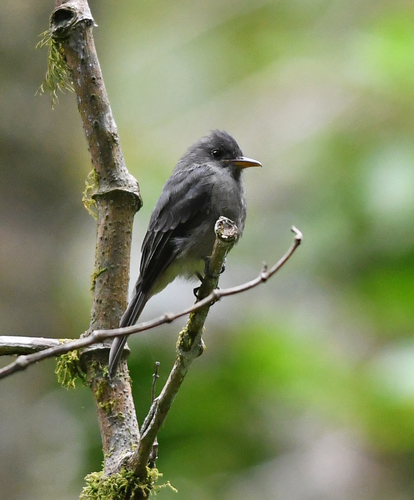
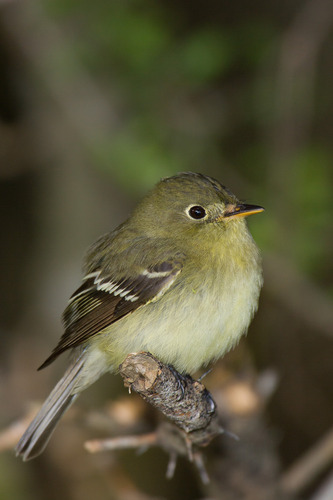
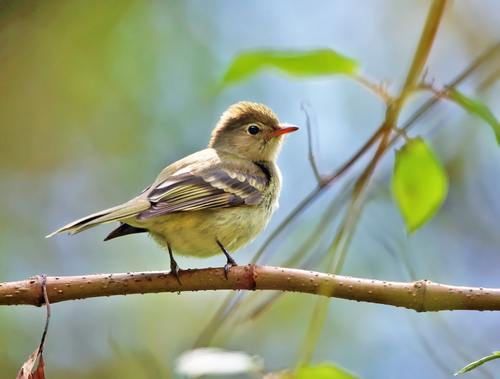
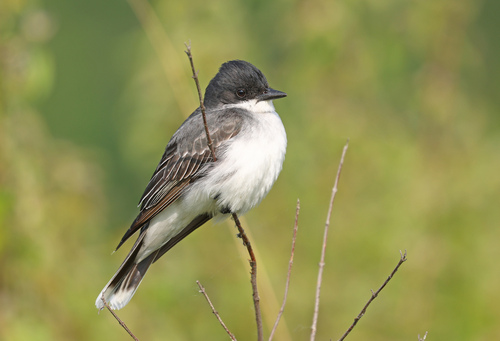
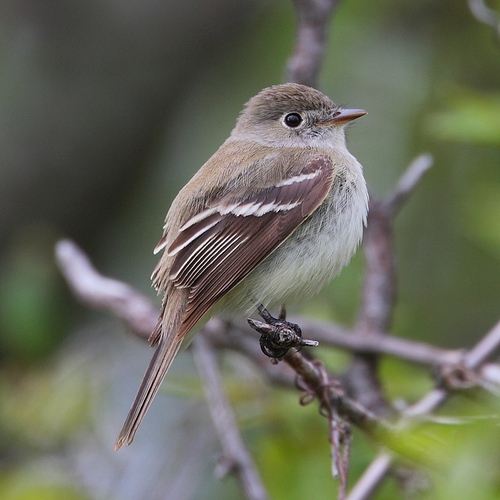
The least flycatcher (scientific name Empidonax minimus) is difficult to distinguish from other members of its genus Empidonax. It is one of the smallest species in the genus, measuring 12 to 14 cm in length, with a wingspan of 19 to 22 cm and an average weight of approximately 10.3 g. Its upperparts are dull olive-gray, and its belly is whitish, notably brighter in color than that of other Empidonax birds. It has two white wing bars, white eye rings surrounding its eyes, and a short beak with a yellowish lower mandible. Juveniles resemble adults, but their wing bars are slightly darker, with tawny or olive tones. Since many other Empidonax flycatchers share these visual field marks, the most reliable way to identify the least flycatcher is through its call and its habitat. The least flycatcher breeds in the eastern Rockies of Canada, and in north-central and northeastern United States. It is a migratory species, spending the winter in Central America from Mexico south to Panama. Its breeding habitats include deciduous or mixed forests, and occasionally coniferous groves. It generally prefers breeding locations near clearings or forest edges, but can also nest in dry woods. Outside of the breeding season, it occupies forest edges and second growth in its winter range. It can also be found in open country, as well as in villages and city parks, where it nests in shade trees, orchards, along rural roads, and at forest edges. Least flycatchers breed in spring, and often nest in close proximity to other pairs of their species. When selecting breeding sites, proximity to conspecific neighbors appears to be more important than habitat quality, and the evolutionary advantage of this behavior is not yet understood, leading to extensive scientific study. Proposed hypotheses for this behavior include that clustered nesting allows the birds to make use of heterogeneous resources, deters predators, or excludes other species with similar resource needs. Courtship behavior in the least flycatcher is not well documented, but it is thought to include males chasing females through trees. Males are aggressive and sing continuously until pairs form. After pairing, the female builds the nest, which is placed either in the fork of a small tree such as maple, birch, or ash, or on top of a large branch. Nests average 12 to 25 inches above ground, but can range from 2 to 65 inches high depending on the habitat. The female weaves a neat cup-shaped nest from fine grass pieces, bark strips, twigs, lichen, spider and caterpillar silk, animal hair, feathers, and other plant materials, and nest building takes around five days to complete. Females typically lay three to five creamy-white eggs, with most clutches containing four eggs. The female incubates the eggs for 13 to 16 days, while the male stays in the area and occasionally feeds her. All eggs hatch within a one to three day window in June. After hatching, both parents bring food to the nestlings. Young least flycatchers make their first flight at 12 to 17 days old, and continue to be fed by their parents for an additional 2 to 3 weeks after fledging.