About Empidonax flaviventris (W.M.Baird & S.F.Baird, 1843)
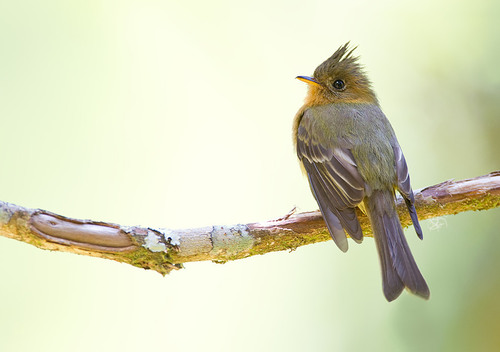
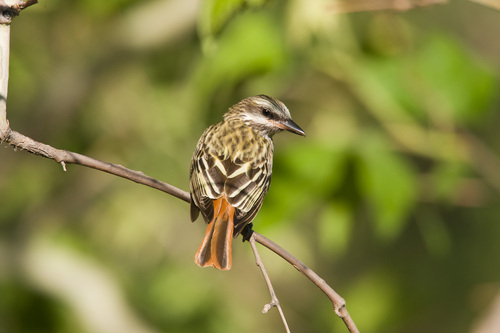
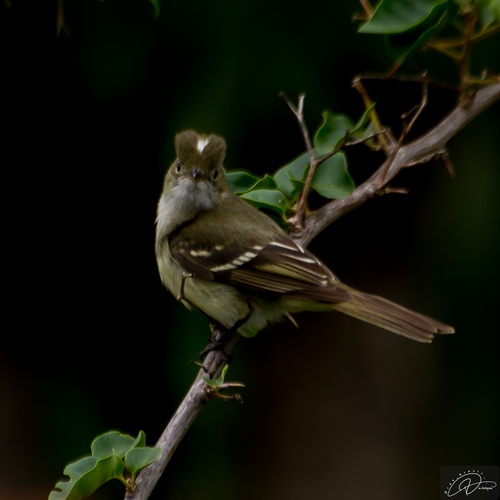
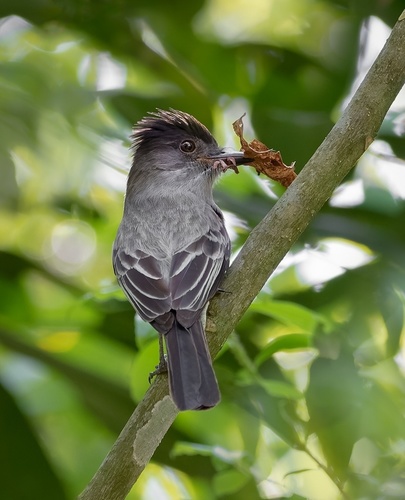
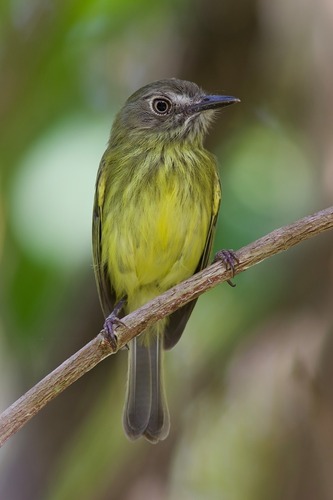
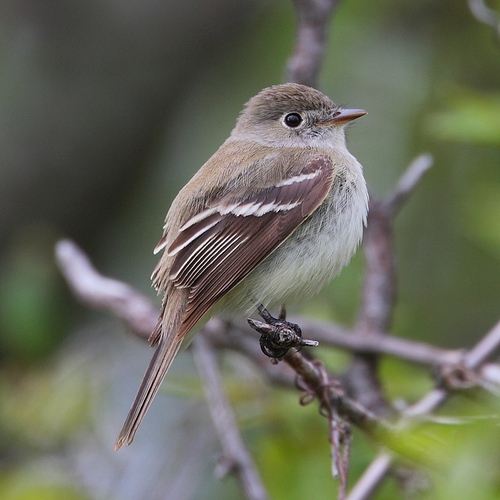
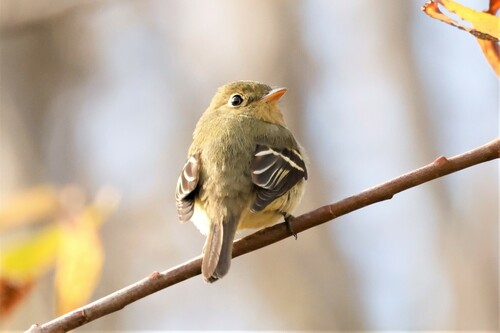
Adult yellow-bellied flycatchers (Empidonax flaviventris) have greenish upperparts and yellowish underparts, with particularly noticeable yellowish color on the throat and a dusky wash across the chest. They have a white or yellow eye ring that does not have the teardrop-shaped projection found on Pacific-slope flycatchers (E. difficilis) or cordilleran flycatchers (E. occidentalis). Their white or yellowish wing bars stand out in strong contrast against their black wings. They also have a broad, flat bill, with a dark upper mandible and an orange-pink lower mandible, and a relatively short tail compared to other species in the Empidonax genus. In 2014, DNA testing confirmed that a field mark based on the extent of buffy edging on the secondaries can reliably distinguish this species from the two species commonly grouped as "Western Flycatchers". This species measures 5.1–5.9 inches (13–15 cm) in length, has a wingspan of 7.1–7.9 inches (18–20 cm), and weighs 0.3–0.6 ounces (8.5–17.0 grams). Yellow-bellied flycatchers hunt by waiting on a perch in the lower or middle sections of a tree, then flying out to catch insects in flight, and will sometimes hover over foliage to hunt. They occasionally supplement their diet with berries or seeds. Their song can be written as a rough, descending "tse-berk", which can be similar to the song of the more common least flycatcher, a snappier, more evenly pitched "che-bek".