About Empidonax flavescens Lawrence, 1865
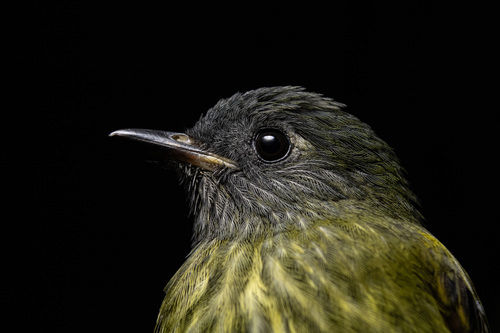
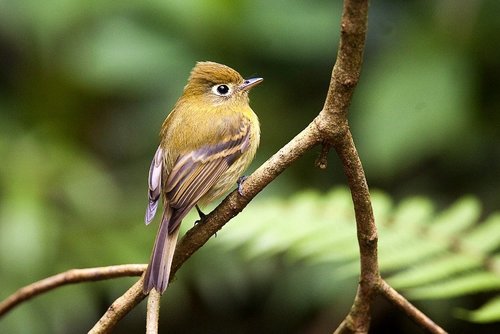
The yellowish flycatcher (Empidonax flavescens Lawrence, 1865) measures 12.5 to 14 cm (4.9 to 5.5 in) in length and weighs 9 to 16 g (0.32 to 0.56 oz), with males and females having identical appearance. Adults of the nominate subspecies have a pale yellow almond-shaped eye-ring on a yellowish green face. Their crown, nape, and upperparts are olive-green. Their tail is dusky to blackish, with yellowish green feather edges. Their remiges are mostly dusky to blackish and glossy: the primaries have pale olive edges, while the outer webs of secondaries and tertials have pale yellow edges. The wing coverts are grayish brown with wide yellow tips that form two distinct wing bars. Their chin and throat are yellowish white, their breast is deep yellow, and the remainder of their underparts are yellowish, with hidden white to yellowish white tufts on the flanks. Feather colors, especially on feather tips, fade as feathers wear. Subspecies E. f. imperturbatus has duller, less yellowish green upperparts than the nominate, plus paler edges to flight and tail feathers, a grayer throat, breast, and flanks, and a more yellowish belly. Subspecies E. f. salvini is larger than the nominate, with greener (less yellowish) upperparts, a greenish olive breast, and a duller yellow belly. All subspecies have a dark brown iris, a black maxilla, a pale pink to orange-yellow mandible, and legs and feet that are light brown, dusky brown, or blackish. The yellowish flycatcher resembles several other species in the genus Empidonax. It is most similar to the pine flycatcher (E. affinis), which shares some overlapping habitat in their shared range. The yellowish flycatcher is brighter and greener than the pine flycatcher, and the two species are easily distinguished by their calls. It also resembles the migratory yellow-bellied flycatcher (E. flaviventris), which winters within the yellowish flycatcher's range; ironically, the yellowish flycatcher has a yellower belly than the yellow-bellied flycatcher, and the two also have different vocalizations. The yellowish flycatcher has a disjunct distribution. Subspecies E. f. imperturbatus has the most limited range, found only in the Sierra de los Tuxtlas of coastal Veracruz in southeastern Mexico. Subspecies E. f. salvini ranges from southern Mexico's Chiapas state south intermittently through Guatemala, El Salvador, and Honduras into northern Nicaragua. The nominate subspecies occurs from central Costa Rica into western Panama, reaching as far as Veraguas Province. This flycatcher inhabits highlands in the subtropical and temperate zones. It occurs primarily in humid evergreen broadleaf forest with abundant moss, lichen, and bromeliads, such as cloudforest, and is also found in pine and pine-oak forest. It favors the forest understory and prefers areas near running water. It mostly lives in the forest interior, but can also be found on forest edges and in human-modified landscapes including coffee and cacao plantations, pastures with scattered trees, and gardens. In the Sierra de los Tuxtlas, it mostly occurs between 900 and 1,660 m (3,000 and 5,400 ft), though individuals have been observed as low as 100 m (300 ft). The other Mexican population in Chiapas ranges between 1,200 and 2,400 m (3,900 and 7,900 ft). In Guatemala, El Salvador, and Honduras, it ranges between 650 and 3,000 m (2,100 and 9,800 ft), but mostly lives above 1,400 m (4,600 ft). It occurs between 800 and 1,800 m (2,600 and 5,900 ft) in Nicaragua, between 800 and 2,500 m (2,600 and 8,200 ft) in Costa Rica, and between 1,050 and 2,225 m (3,400 and 7,300 ft) in Panama.