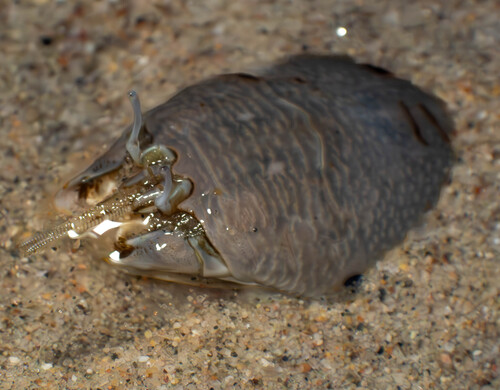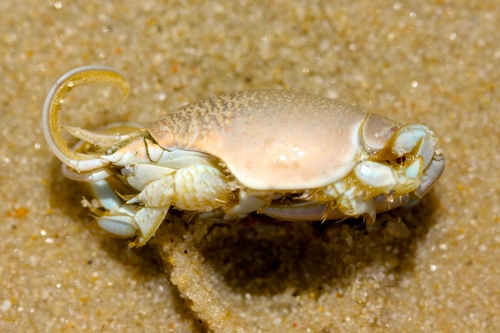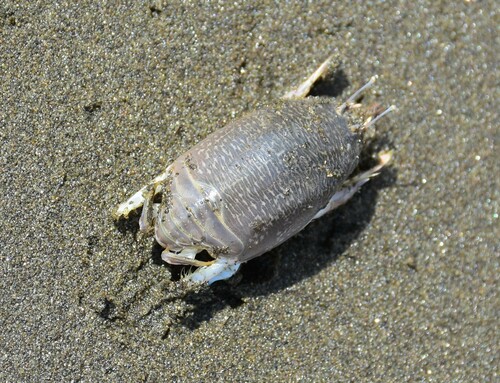
About Emerita rathbunae Schmitt, 1935
Emerita rathbunae shows an extreme form of sexual dimorphism. Tiny neotenous males attach to the appendages of females, pushing the genus’s common trend of small male size almost to the point of parasitism. Sexually mature females typically have a carapace length of 33–44 mm (1.3–1.7 in), while males reach only 2.5–3.0 mm (0.10–0.12 in).
Emerita rathbunae occurs on eastern Pacific Ocean shores, ranging from the southern end of Mexico’s Gulf of California to Iquique in northern Chile, and is also present in the Galápagos Islands. In the southern part of its range, it lives alongside the southern population of Emerita analoga, which extends as far north as mainland Ecuador. Even though the two species co-occur in this area, E. analoga is not the closest relative of E. rathbunae. Instead, E. rathbunae belongs to a clade that also includes western Atlantic species E. portoricensis and E. benedictii. It is hypothesized that the last common ancestor of the entire Emerita genus lived in the Pacific Ocean, and colonized the Gulf of Mexico when the Isthmus of Panama was submerged. E. rathbunae is thought to have recolonized the Pacific in a similar event, from ancestors that lived on the Atlantic side of the Isthmus of Panama.
Emerita rathbunae was first formally described by Waldo L. Schmitt in 1935. Its type locality is Punta Chame in Panama, and the holotype is held by the United States National Museum under specimen number USNM 47887. The specific epithet rathbunae honors Mary J. Rathbun, an American carcinologist.
E. rathbunae inhabits the intertidal zone, where it uses beach swash for movement and filter-feeding. In Ecuador, it is one of the most abundant species that move with the swash, alongside the sea snail Olivella semistriata. The two species avoid competition: E. rathbunae prefers steeper beaches with coarser sediment and rougher swash than O. semistriata, and also positions itself lower in the swash zone than the snail. Based on comparisons with other species in the Emerita genus, E. rathbunae is thought to be a very strong swimmer that can burrow into sand rapidly.