About Emerita analoga (Stimpson, 1857)
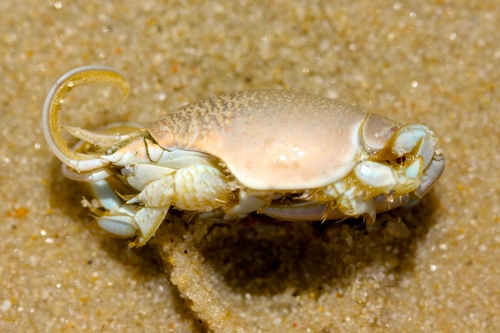
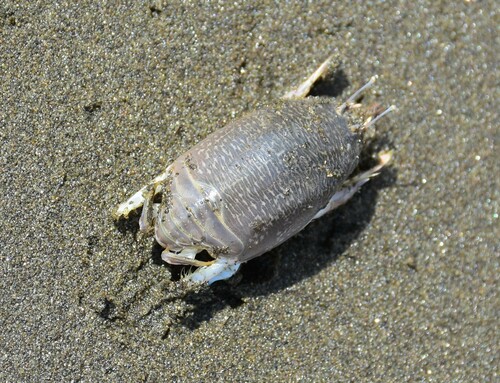
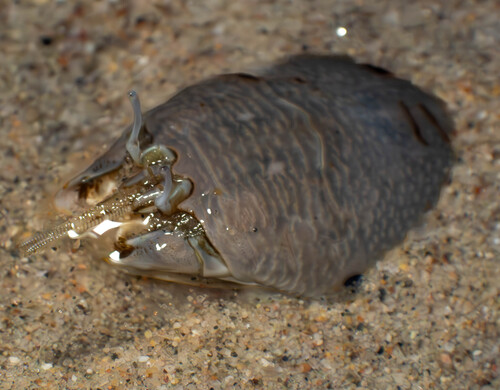
Description: The Pacific sand crab, Emerita analoga, is a small crustacean that reaches up to 35 mm (1.4 in) long and 25 mm (1.0 in) wide. Females are nearly twice as large as males, and can often be identified by the orange egg mass they carry under the telson. Adult Pacific sand crabs are sand-coloured for effective camouflage, have no claws or spines, five pairs of legs, and three pairs of pleopods. These crabs moult periodically, so their discarded exoskeletons are commonly found washed up on beaches. The species is well adapted to life in the unstable substrate of sand, with an elongated dome shape built for fast burrowing. Its eyes sit on long stalks, and its antennules are also elongated to project above the sand surface; these antennules form a tube that channels water downward through the crab's gills. Its much longer antennae are retractable; when water covers the sand, these antennae also extend above the sand surface to collect food particles. The legs and uropods have hairy margins that assist with digging, collecting food, and transferring food to the mouth. Distribution: This sand crab occurs along the Pacific coast of the Americas: in North America from Alaska to Baja California, and in South America from Salaverry, Peru southward to around Cape Horn and into southern Argentina. The species is common on California beaches, but larger population fluctuations occur further north. These fluctuations are likely caused by variations in coastal currents that passively disperse the planktonic larval stages northward in some years. Oregon populations do not appear to be self-sustaining, and most new recruitment comes from larvae originating in California. There is an established population on the Twin Harbors Peninsula of Washington state. On any individual beach, the distribution of sand crabs can vary greatly between different sections, for reasons that are not fully understood. Females are typically found further down the beach, while males and immature crabs are found at higher shore levels. Ecology: Pacific sand crabs live just below the sand surface, moving up and down the beach with changes in tide. As each wave advances and retreats, the crab moves to the surface and extends its antennae to feed. This activity makes it vulnerable to predatory birds such as sanderlings, which actively patrol the area of the beach washed by incoming waves and probe softened sand with their bills. The crab retreats back under the sand surface as each wave recedes, maximizing its chance of staying out of reach of the bird's bill, while the bird maximizes its chance of catching crabs by scurrying along the edge of the surf. Other birds that prey on Pacific sand crabs include willets, godwits, surf scoters, black-bellied plovers, and curlews. These crabs act as hosts for the intermediate life stages of several types of parasitic worms, including acanthocephalans. These parasites are passed on to predators that eat the infected crabs, and ingesting a large enough number of these worms is known to kill the predator. Barred surfperch (Amphistichus argenteus), found off the California coast, consume large numbers of Pacific sand crabs. Surf fishermen use these crabs as bait, and commercial bait fisheries harvest them from beaches. Recently moulted soft-shelled sand crabs are kept for bait, while hard-shelled crabs are thrown back into the sea. Pacific sand crabs are used as an indicator species to monitor populations of domoic acid-producing diatoms in the genus Pseudo-nitzschia, which sometimes form toxic blooms off the coast of California.