About Emblema pictum Gould, 1842
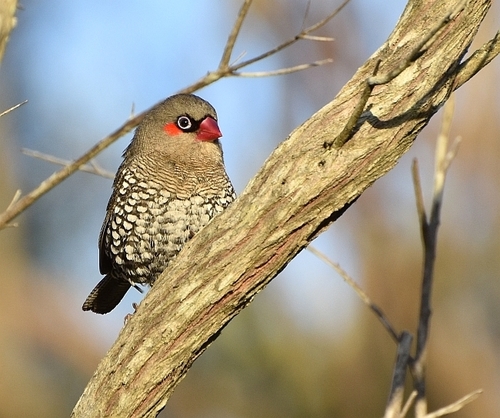
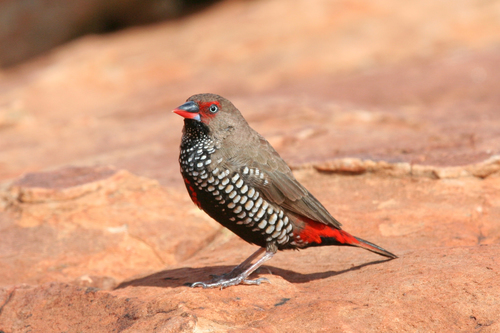
The painted finch (Emblema pictum Gould, 1842) is a small passerine bird, measuring 10–12 cm (3.9–4.7 in) in length and weighing approximately 11.5 g (0.41 oz). Males have a striking red forehead and face that contrasts sharply with their black breast. They also have a bright red patch at the center of the breast, while the sides of the breast, belly, and flanks are black with white spots. The tail, upper body, and upper wing are reddish-brown, and the rump and uppertail coverts are mostly red, making them highly visible when the bird is in flight. Painted finches have a long, slender, pointed bill: in males, the upper mandible is mostly black with a red tip, and the lower mandible is mostly red with light blue-grey patches on either side of the base. Male painted finches have cream or off-white irises, and their legs range in color from dark brown to pinkish. Females are similar in appearance to males, but their red facial coloration is duller and restricted to the lores, cheeks, and area around the eyes. Their red breast patch is also duller than that of males, and their underparts are generally a duller brownish-black, though they have more spotting than males. The female bill is similar to the male's but typically has less red on the upper mandible. Females also have cream or off-white irises, and their legs range from dark brown to pinkish. Juvenile painted finches resemble females, but their underparts are duller and browner. Juveniles have no red coloration on the face, and their bill is black, turning paler and almost pinkish on the lower portion. Juveniles have grey-brown eyes. Painted finches inhabit arid and semi-arid zones, living in rocky areas with ground cover of spinifex grass. Their native range includes Western Australia, northern Australia, Queensland, and South Australia. In 2007 and 2008, large numbers of painted finches moved into western New South Wales; the species has since been recorded breeding there, and a resident population is now thought to be established. When conditions are favorable, painted finches can breed at almost any time of year. Eggs have been recorded in all months except November and December, and nestlings have been recorded between March and October. Courtship typically takes place on the ground, where both sexes pick up and drop twigs or other objects. This behavior may be replaced by a greeting display, in which the male sings to the female while holding a vertical posture, raises his body feathers, and pivots his head from side to side. Painted finches are monogamous and nest as simple pairs. Nesting sites are usually well-concealed clumps of spinifex grass, though pairs have also been observed nesting in natural cavities near the top of a clump, or on the ground at the base of a clump. Occasionally, nesting sites may also be in other species of tussock grasses or low shrubs. Painted finches build loose, bottle-shaped or domed nests with a wide entrance. The nest is usually built from spinifex stems, but may also include other grass stems, twigs, or rootlets. Nests are often lined with feathers, plant down, hairy seeds, grass, wool, fur, or balls of fluff. The nest entrance is frequently decorated with a piece of charcoal. Females lay clutches of 3 to 5 oval white eggs, which sometimes have a faint blue tint. Both the male and female incubate the eggs for around 13–14 days. The hatchlings are altricial, and do not leave the nest until they are 21–26 days old. The young are fed for approximately two more weeks after fledging, and they begin to develop courtship behavior at 10 weeks old.