About Embiotoca jacksoni Agassiz, 1853
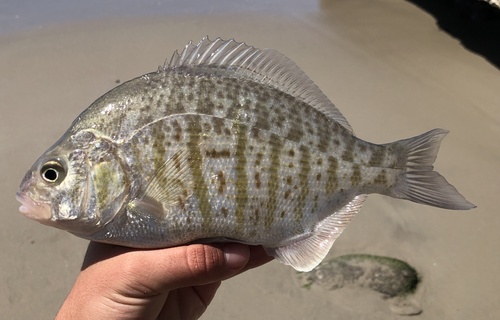
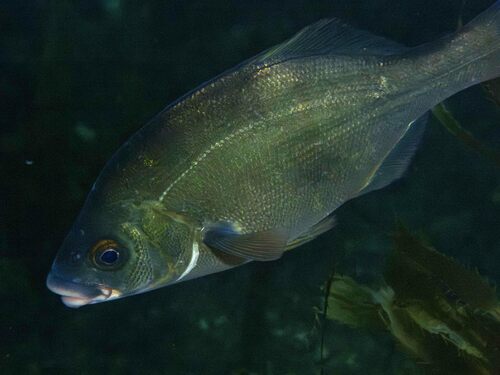
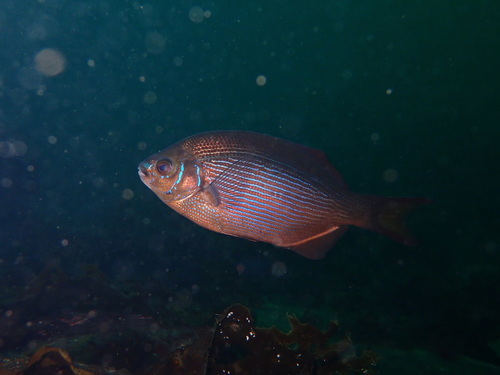
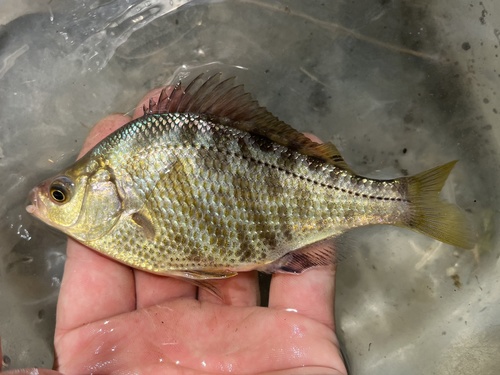
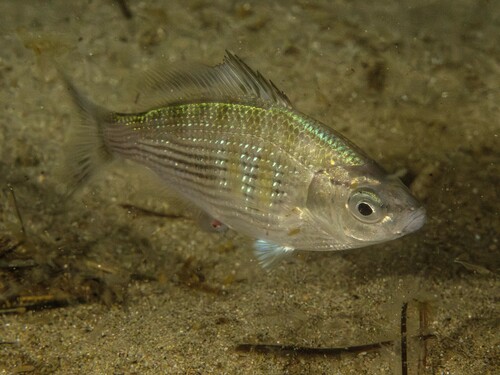
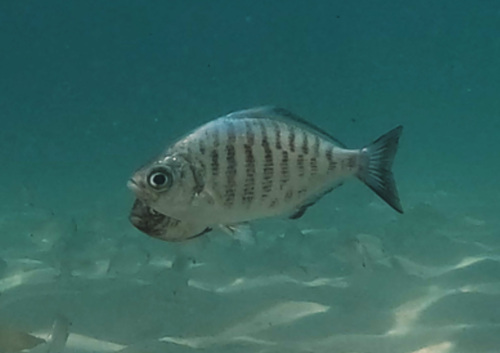
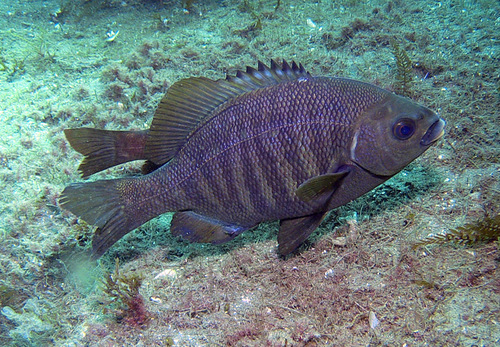
Embiotoca jacksoni, commonly called the black surfperch, has a laterally compressed frontal profile and a deep body. Despite its common name, this species is not black. It is most often a uniform dark reddish brown to tan, and frequently has large darker vertical bars across its body. This distinguishes it from striped surfperches, which have horizontal orange and blue stripes. Rarely, black surfperches can have a paler silvery to greenish-white body with fainter bars, which makes them resemble barred surfperches (Amphistichus argenteus). Even when this color morph occurs, black surfperches can still be identified by a patch of enlarged scales between their pectoral and pelvic fins. This species reaches a maximum length of 38 cm (15 in) and a maximum weight of 1.22 kg (2.7 lb). Its thick lips are yellowish, and often have a darker "mustache" marking above the upper lip. The tail and pelvic fins are usually orange to reddish, and may occasionally have gold and dark blue stripes. Black surfperches are thought to be able to change color for camouflage. Black surfperches are native to the eastern Pacific Ocean, ranging from the shallow coastal waters around Fort Bragg, California, to Punta Abreojos, Baja California Sur, and are also found off Guadalupe Island. Individuals have also been recorded entering Northern San Francisco Bay. They typically occur alone or in small groups of three to four, most often at depths up to 6.1 m (20 ft), but can be found as deep as 46 m (151 ft). They inhabit rocky areas, reefs, eelgrass beds, and kelp forests, and are occasionally found in sandy areas near human-built structures such as piers or pilings. During the summer mating season, male black surfperches develop a pair of nipple-like organs that extend from their anal fins. Like all surfperches, this species is viviparous, meaning it gives birth to live young. Black surfperches reach sexual maturity at one to two years of age, when they grow to a length of 15 cm (5.9 in), and can live up to nine years. They are carnivorous, and feed primarily on small invertebrates during the day. Their most common prey includes gammarid amphipods and other crustaceans, but they also eat worms, brittle stars, bryozoans, small crabs, and mollusks. They have been observed eating large amounts of substrate gravel to filter out food items, then spitting out the non-nutritious debris. Smaller black surfperches act as cleaner fish, eating ectoparasites from other fish species.