About Emberiza tahapisi A.Smith, 1836
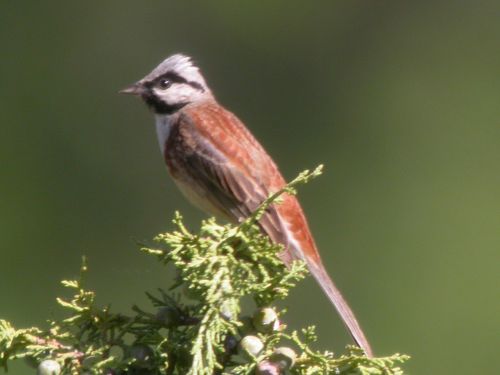
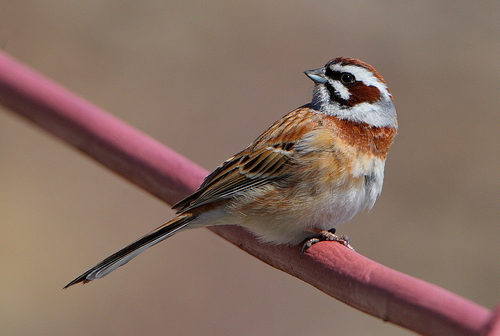
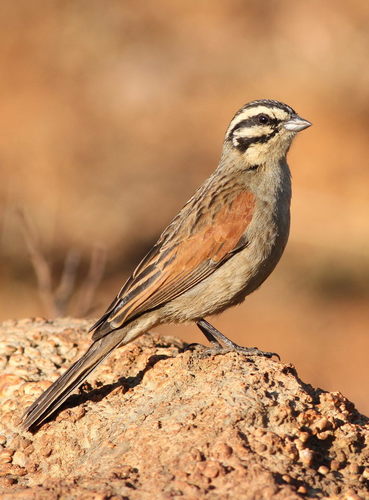
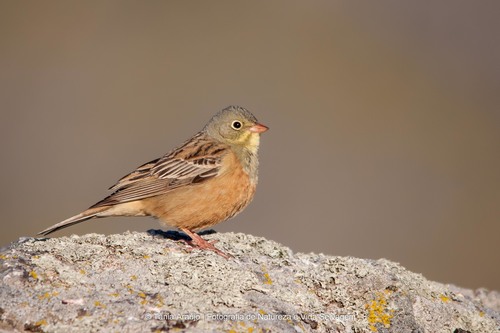
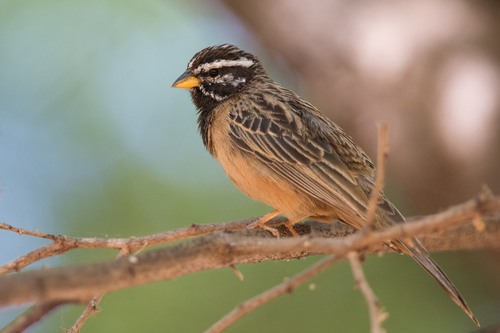
Cinnamon-breasted buntings (Emberiza tahapisi A.Smith, 1836) weigh between 11.6 and 21 grams, and have a body length of 13 to 15 centimeters. While their plumage differs between juveniles, males, and females, the species can be identified by their striped heads and cinnamon brown underparts. Males have black and white head stripes, while female stripes are less dark and browner. Male cinnamon-breasted buntings have a uniformly black throat patch, which is smaller, grayish, and densely blotched on females. Juveniles resemble females, but have buffier head stripes and a paler, browner throat. After the breeding season, juveniles undergo a partial moult, while adults moult completely, leaving all primary and secondary flight feathers the same age. The song of the cinnamon-breasted bunting is made up of short, high-pitched, rapid trills. Males have eight distinct songs that include 40 discrete syllables. Song similarity between local populations decreases as geographic distance between the populations increases, but all songs end with a characteristic final whistle syllable. Individuals sing from elevated perches such as trees, bushes, or rocks. Cinnamon-breasted buntings have a very widespread distribution across most of mainland sub-Saharan Africa, though they do not occur in deserts, equatorial forest, or high mountain altitudes. They inhabit rocky, lightly wooded hillsides with sparse vegetation and bare soil, and can sometimes be found in woodlands. Some populations are partially migratory: certain groups move north during the rainy season, south during the dry season, and to lower elevations during winter. Breeding timing for cinnamon-breasted buntings varies to align with a region's rainy season. In arid regions with low rainfall, breeding occurs throughout the rainy season, while in regions with heavier rainfall, breeding takes place at the end of the rainy season. The species is monogamous, and individuals nest solitarily. Nests are built from twigs and grass, and are typically placed on the ground in a shaded area. Both males and females perform incubation and care for hatchlings. Incubation lasts 12 to 14 days, and offspring fledge 14 to 16 days after hatching, but continue to feed within the parental territory for three weeks. Clutch size ranges from 2 to 4 eggs, which are greenish-white or bluish-white with dark brown or reddish-brown speckles. Cinnamon-breasted buntings are ground gleaners that primarily eat seeds, and have also been recorded eating insects, especially in captivity. They will sometimes jump to pull seeds. Parents feed chicks a mix of seeds and insects. Individuals are most commonly seen alone or in pairs, but may also form small flocks of 3 to 4, and less frequently 6 to 8. Migrating birds may gather in flocks as large as 40 individuals. Tail flicking is a common behavior for the genus Emberiza; cinnamon-breasted buntings perform this while hopping on the ground to make themselves more conspicuous to mates and other birds. Courtship behavior includes males chasing females through the air, males carrying nest materials to the nest and performing nest shaping movements, and females quivering their wings while producing a special repeating eep call. Aggressive behavior consists of a head-forward posture paired with bill snapping or gaping; bill snapping occurs more often when fear is stronger than aggression. Special chaa, eee, and chu chatter calls are produced during fights. Fear responses include freezing and observing when the perceived threat is low, fleeing, and giving alarm calls. Higher intensity fear response may include mobbing the threat.