About Emberiza sulphurata Temminck & Schlegel, 1848
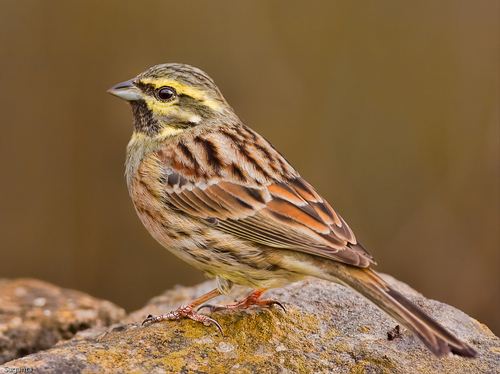
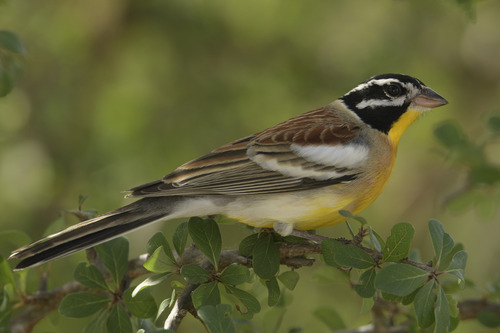
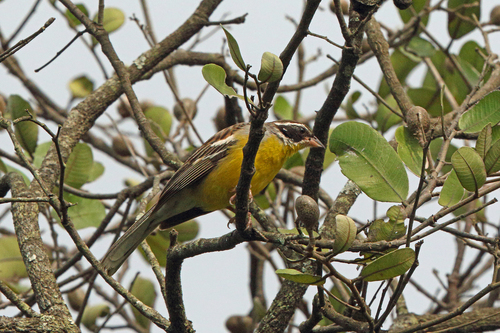
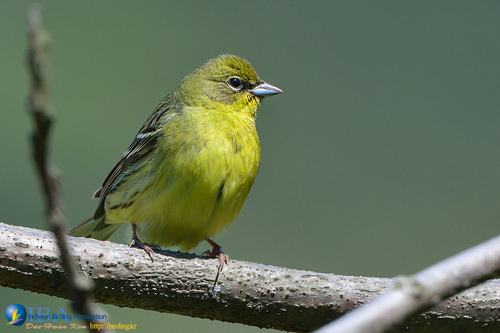
This bird species, Emberiza sulphurata, commonly called the yellow bunting, measures 14 cm in length. It has a conical grey bill, pinkish-brown feet, and brown eyes. Males are grey-green on their upperparts, with black streaks running across the back. Their underparts are yellow-green, brightest on the throat and belly, with streaks on the flanks. Males also have black lores, a narrow black chin, a pale eye ring, white outer tail feathers, and two wing bars created by pale tips on the median and greater wing coverts. Females resemble males but are paler, and lack the black markings on the lores and chin. This species produces a twittering song and a soft tsip call. Its breeding season runs from mid-May to early July. Nests are built low in bushes, and clutches contain three to five eggs. The yellow bunting breeds only in Japan, where it is uncommon. Most breeding populations are found on Japan's largest island, Honshu, though it may also breed on Kyushu, and possibly bred on Hokkaido in the past. Breeding individuals occupy forest and woodland at elevations between 600 and 1500 metres above sea level, mostly in central and northern Honshu. A small number of yellow buntings winter in warmer regions of Japan, while most migrate further south. During the winter season, it has been recorded in the Philippines, Taiwan, Hong Kong, and southeast China, but it is scarce in all these locations. In winter, it lives in woodland, scrub, grassland, and farmland. Small numbers pass through Korea during spring and autumn migration. As of 2021, the species' total population remains unknown. The population is considered stable or possibly increasing, and is likely much larger than earlier population estimates suggested. The IUCN classifies this species as least concern. Threats to the yellow bunting include habitat loss, pesticide use, and trapping for the cagebird industry.