About Emberiza sahari J.Levaillant, 1850
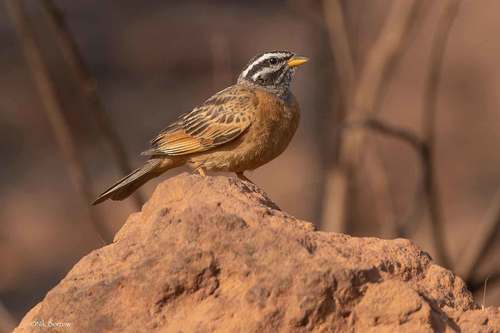
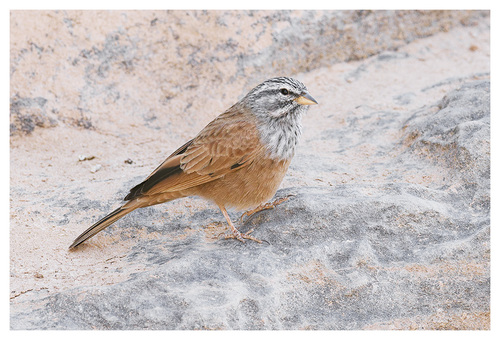
The house bunting, with the scientific name Emberiza sahari, is a passerine bird that belongs to the bunting family Emberizidae. It is a non-migratory breeding bird native to dry regions of northwestern Africa, ranging from Morocco south to Mali and east to Chad. In Morocco, this species has expanded its range northward from the Atlas Mountains since the 1960s, and has recently reached Tangier and Tétouan on the southern shore of the Strait of Gibraltar. The house bunting bred in Europe for the first time in 2023, at Algeciras in southern Spain. The house bunting breeds near human settlements, and builds its nest in a hole in a wall or building, where it lays two to four eggs. Its natural diet consists of seeds; when feeding its young, it feeds on insects. It reaches 14 cm in length, which is similar in size to the striolated bunting, and smaller than the rock bunting. Breeding males have a sandy orange-brown body and a grey head with faint dark streaks; unlike the striolated bunting, it does not have a white supercilium. Females have grey heads with a brown tint, and more diffused streaking on the head. The house bunting was recently split from the closely related striolated bunting, of which it was previously treated as a subspecies under the name Emberiza striolata sahari. Compared to the house bunting, the striolated bunting has stronger facial striping and a paler belly. For a clutch of three house bunting eggs, the incubation period is 12 to 14 days. When the house bunting sings from a perch, its song is similar to that of the common chaffinch, but weaker. In Morocco, the species is traditionally considered sacred, so it has become very tame, and freely enters and feeds inside houses, shops, and mosques.