About Emberiza pusilla Pallas, 1776
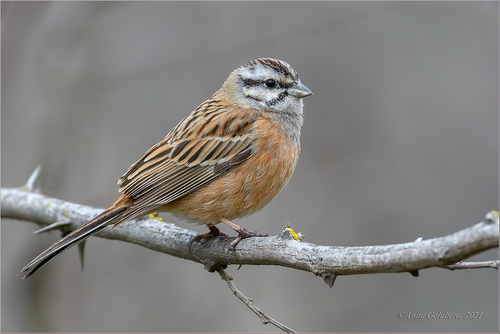
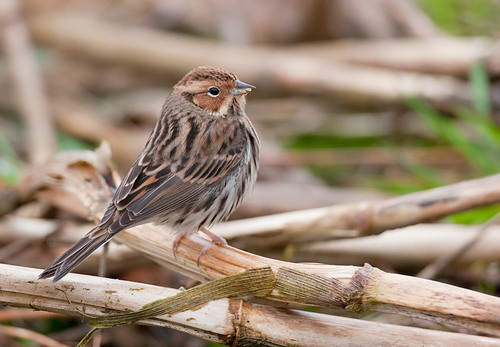
This species, the little bunting, is a small bunting with a total length of 12–14 cm (4.7–5.5 in). Its underparts are white, with dark streaking across the breast and sides. It has a chestnut face and a white malar stripe, which gives it a general resemblance to a small female reed bunting. It can be distinguished by additional features: black crown stripes, a white eye-ring, and a fine dark border along the back of its chestnut cheeks. Males and females look similar. The species produces a distinctive zik call, and its song is a rolling siroo-sir-sir-siroo. The little bunting breeds across the taiga of far northeastern Europe, northern Eurosiberia, and extending to the Russian Far East. It is a migratory species, wintering in the subtropics of northern India, southern China, and the northern regions of southeast Asia. Little buntings stay in their winter range for quite a long time; specimens have been collected in Yunnan as late as late March. It occurs only as a rare vagrant in western Europe. This species is adaptable; for example, when small numbers winter in the mountains of Bhutan, it is typically found in agricultural habitats, mostly between 1,000 and 2,000 metres (3,300 and 6,600 ft) above sea level. It breeds in open coniferous woodland, often mixed with some birch or willow. It lays four to six eggs in a nest placed in a tree. Its natural diet consists of seeds, and it feeds insects to its young. It is a common, widely ranging species, and is not classified as threatened on the IUCN Red List.