About Emberiza cioides J.F.Brandt, 1843
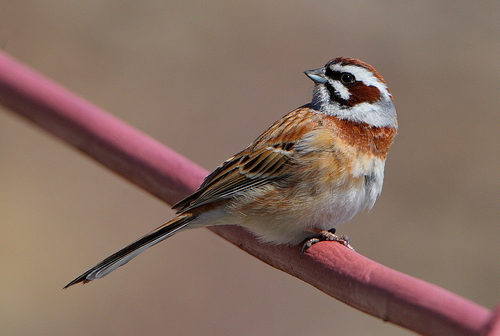
Emberiza cioides, commonly known as the meadow bunting, measures 15 to 16.5 centimeters in length. Males are predominantly rufous-brown with dark streaks along their backs. Their heads have a bold pattern: they are brown, with white eyebrows, a white moustachial stripe, and a white throat, plus grey coloring on the sides of the neck. The species has white outer tail feathers and pinkish-brown legs. Females have a similar overall appearance, but their plumage is duller and paler, and their head pattern is less clearly defined. The meadow bunting’s song is a short, hurried phrase delivered from a prominent exposed perch. Its call is a sequence of up to four sharp notes. This species breeds across southern Siberia, northern and eastern China, eastern Kazakhstan, Kyrgyzstan, Mongolia, Korea, and Japan. It is largely non-migratory, though birds breeding in northern parts of its range move south as far as southern China and Taiwan. There have been multiple records of the species in Europe, but most of these sightings are believed to involve birds that escaped from captivity, rather than wild genuine vagrants. Meadow buntings live in dry, open habitats including scrub, farmland, grassland, and open woodland. They build their nests low in bushes or directly on the ground. Females lay three to five eggs per clutch, which are incubated for 11 days. After hatching, young meadow buntings fledge 11 days later. Breeding pairs are monogamous, and they will reuse the same breeding territory for multiple consecutive years.