About Emberiza capensis Linnaeus, 1767
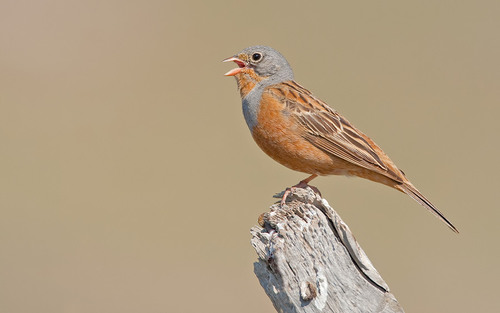
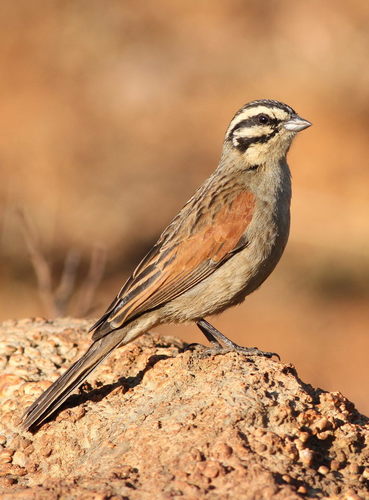
The Cape bunting, with the scientific name Emberiza capensis Linnaeus, 1767, measures 16 cm in length. Adult individuals have a black crown, a white supercilium, and white ear coverts bordered with black. Their upperparts are grey-brown with some dark streaks, their wing coverts are chestnut, and their tail is a darker chestnut. Their underparts are grey, with a pale throat. The sexes of the Cape bunting are very similar in appearance, but females may have a buff tone to the white markings on their head. Young birds have duller chestnut wings, a less distinct head pattern, and heavier streaking that extends to the breast and flanks. The call of the Cape bunting is an ascending zzoo-zeh-zee-zee. Its song is a loud chirping sequence: chup chup chup chup chee chhep chu. The subspecies E. c. vincenti has a simple song that sounds like tre-re-ret tre-re-ret. The Cape bunting is found in southern Africa, ranging from south-western Angola, eastern Zambia, Zimbabwe and southern Tanzania to the Cape. Its typical habitat is rocky slopes and dry weedy scrub; in the northern part of its range, it mainly occurs in mountains. It previously occupied stony arid areas with some short grass, but much of this habitat has been lost to ploughing.