About Emberiza buchanani Blyth, 1845
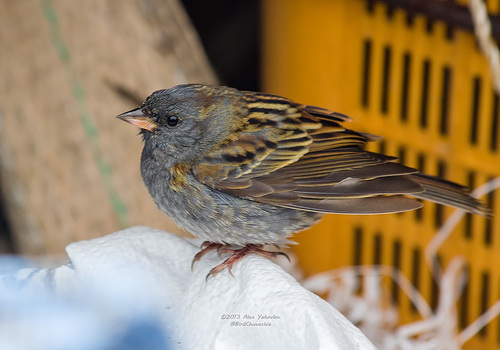
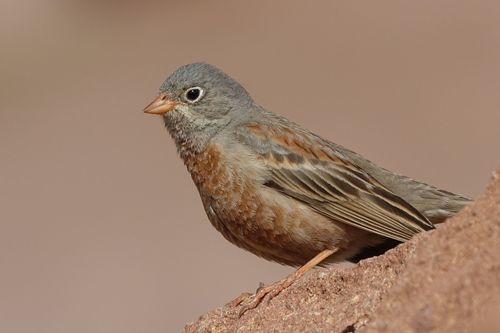
This species of bunting has a long pink bill and greyish upperparts. Males have a distinctive white eye-ring that contrasts sharply with their grey hood; their chin and throat are whitish pink, bordered by grey malar stripes, and their underparts are pinkish brown. Females are duller overall, but their moustachial stripe is often more noticeable. The outer tail feathers of this bunting are whitish. The species was described by Edward Blyth, based on a drawing by Francis Buchanan-Hamilton, for whom the species is named. Due to publication delays for The Asiatic Society's journal, it is suggested the actual year of description is 1845. A purported type specimen held at the Indian Museum has never been located. In winter, this bunting produces a short, subdued click call, while its song is a metallic jingle of swee-swee notes that ends in dzwe-ee-dul; when sung from a perch, the song is a series of short, shrill notes that increase in volume. Three subspecies are recognized: the nominate Emberiza buchanani buchanani, E. b. neobscura, and E. b. ceruttii. This bunting occurs primarily in dry, open habitats, most often stony, scrubby hillsides covered with low thorn scrub. Its natural habitat is temperate grassland, mainly located below 7000 feet. In winter, it can be found in weedy or stubbly fields. It nests on the ground beneath overhanging vegetation, and its nest is lined with grass and hair. Birds that breed in the Baluchistan region migrate to India for the winter, passing through Gujarat in September and returning to their breeding grounds in March. The species is found across Afghanistan, Armenia, Azerbaijan, Bhutan, Nepal, China, Hong Kong, India, Iran, Israel, Kazakhstan, Mongolia, Oman, Pakistan, Russia, Syria, Tajikistan, Turkey, Turkmenistan, and Uzbekistan. It is an extremely rare vagrant north of its breeding range, with recent records from Finland and the Netherlands. Wanderers may be overlooked because, in non-breeding plumage, they closely resemble the closely related, much more common ortolan bunting. This bunting winters in parts of Africa, West Asia, and South Asia, ranging as far south as Sri Lanka. The tick Hyalomma turanicum has been recorded on individuals of this species from Kazakhstan. Claud Ticehurst observed that males and females of this species migrate separately.