About Elysia viridis (Montagu, 1804)
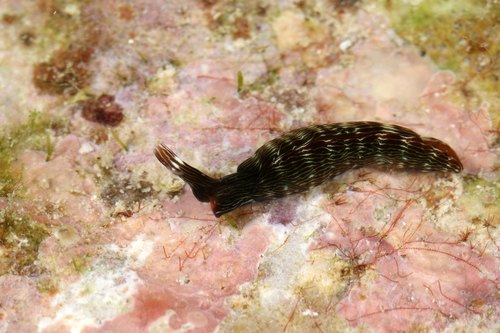
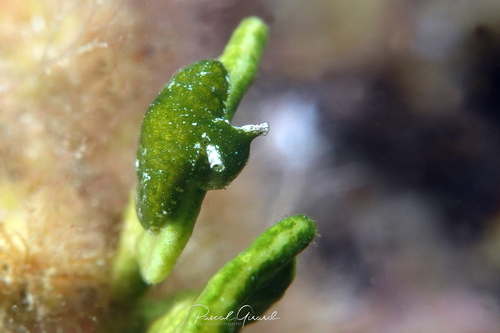
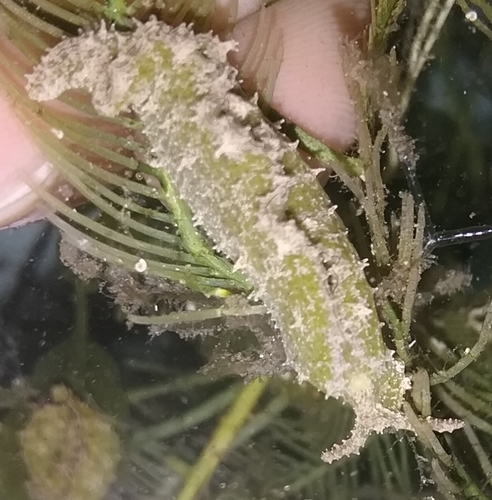
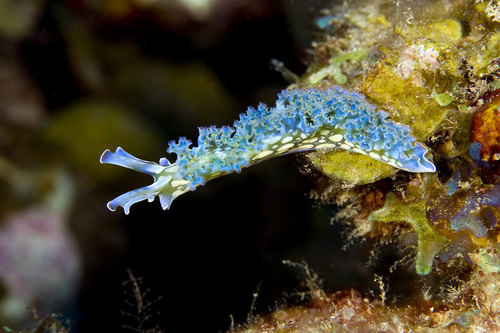
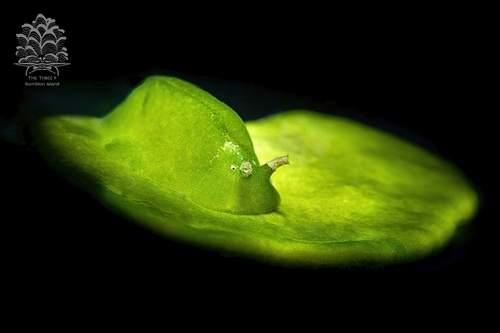
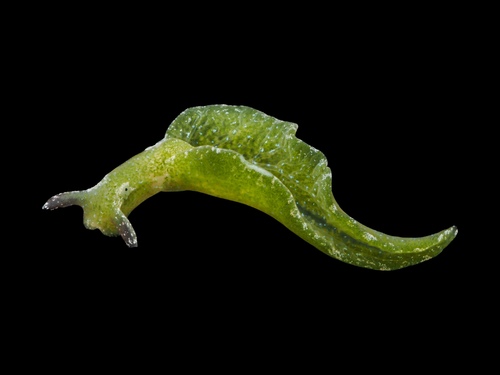
Description: Adults of Elysia viridis are 15 to 20 mm long, and healthy adults weigh between 15 and 20 mg. The surface of this sea slug is covered in tiny glistening spots that can be red, yellow, blue, or green. Parapodia extend out from the sides of the slug, and these structures are the main site where captured chloroplasts are held. Rhinophores extend upward from the slug's head. Elysia viridis feeds using radular teeth; a note on radular tooth variation originally attached to this species description incorrectly referenced Elysia gordanae, stating that tooth shape can vary based on an individual's diet. Distribution: Elysia viridis is found in the Northeastern Atlantic, mostly around the British Islands. It has also been recorded further north in Sweden and Norway, and in the Mediterranean Sea. A 1987 publication reported Elysia viridis from South Africa, but the same author later revised the specimen's identification to an undetermined Elysia species. This species lives in the intertidal zone, and is typically found submerged on its algal prey between 1 and 5 meters below the water surface. Ecology: Elysia viridis feeds on algae, mostly species from the genus Codium, and shows a preference for Codium fragile, Codium sericea, and Codium rupestris. Compared to other species in the genus Elysia, E. viridis is less selective when choosing algal hosts. E. viridis lays coiled egg masses on the thallus of its prey algae, or on nearby underwater surfaces. Eggs hatch into a larval stage called a veliger. Veligers are planktotrophic, and eat free-floating unicellular algae. Once larvae develop a propodeum, they search for a macroalgal host. Contact with a macroalgal host appears to trigger metamorphosis into the adult form, though this triggering effect has not been confirmed.