About Elysia pusilla (Bergh, 1871)
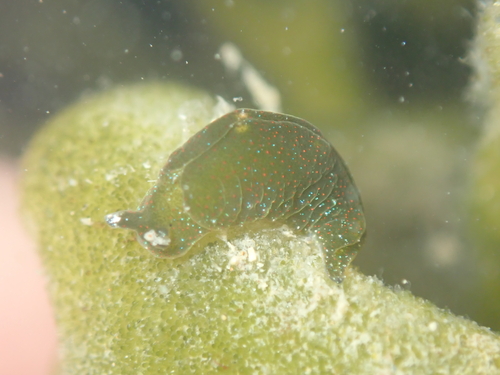
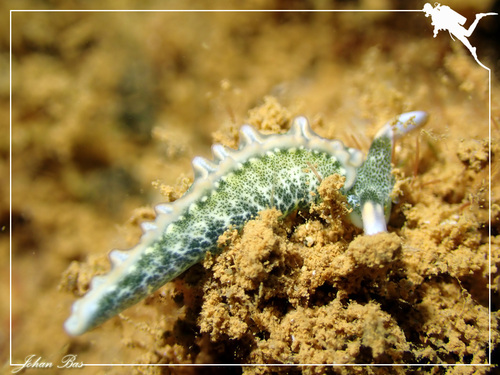
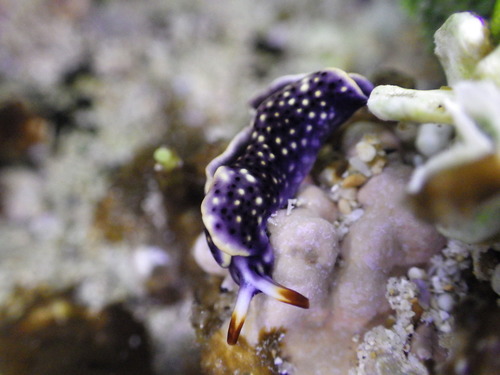
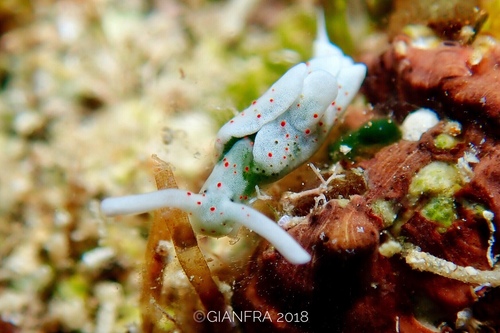
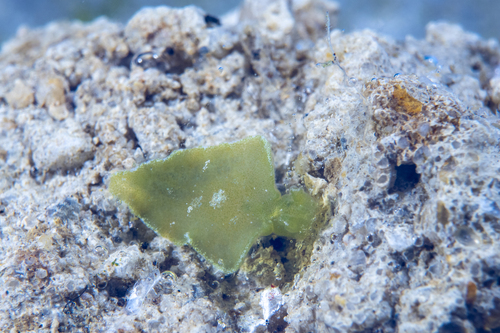
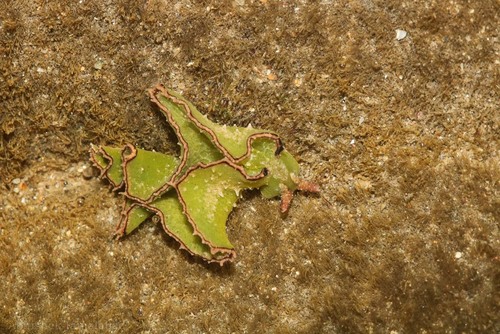
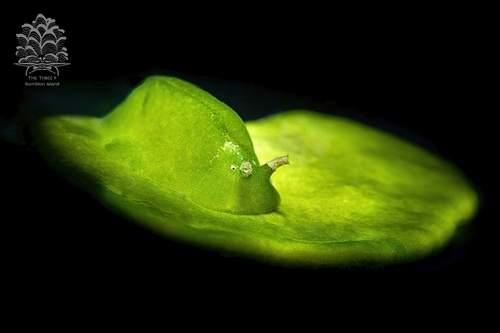
Elysia pusilla (Bergh, 1871) is a species of cryptic sea slug that typically grows between 1 and 3 centimetres (1.2 in) long. Its color and shape closely match the alga it feeds on, for camouflage. When living on older Halimeda taenicola foliage, it is flattened and mottled pale green; on fresh new growth of the alga, it takes on a brighter green shade; and on the alga’s cylindrical shoots, it develops a more circular cross section. This sea slug is found exclusively on the calcareous green alga Halimeda taenicola, and the alga’s shape influences the slug’s own shape: it tends to be more flattened when living on broader Halimeda segments, and more cylindrical when living on cylindrical Halimeda segments. The species’ uniform green color comes from ingested chloroplasts that are stored in its tissue, and it occasionally has small white spots. Like many Elysia species, Elysia pusilla has wing-like flaps called parapodia, but its parapodia are partially fused and smaller than those of other Elysia species, leading some scientists to place this species in a separate genus. On top of its head are white, club-shaped sensory organs called rhinophores (also called cephalic tentacles); these rhinophores may detect chemical stimuli that act as an indicator for metamorphosis. As a member of the phylum Mollusca and class Gastropoda, Elysia pusilla has a soft body, a ventralized foot for movement, a radula and long guts used for feeding, and a mantle for protection. It is bilaterally symmetrical, with three tissue layers that form a body cavity called a coelom, and holds organs that are independent of the body wall. As a nudibranch, it has no gills, and breathes through secondary gills in its skin, using tentacle-like structures called cerata on its back. In many nudibranchs, cerata are blood-filled tubes that act as an extension of the digestive system and can be used for defense; in aeolid nudibranchs, cerata hold sacs called cnidosacs that store nematocysts (stinging cells acquired from cnidarians eaten during feeding). Sacoglossans as a group are found in temperate and tropical oceans, with most living in the Central Pacific. Elysia pusilla specifically is found in the tropical Indo-Pacific Ocean, while related species live in the Caribbean. This species occurs at depths between 0.5 and 0.9 metres. Elysia pusilla lays its eggs in a spiral formation, and eggs usually hatch after 6 days. This species may be capable of poecilogony, a rare intraspecific reproductive pattern where a single species produces two different larval modes. Egg dimorphism (different egg sizes) produces two larval types in poecilogony: planktotrophic larvae, which must feed on plankton to grow and develop, and lecithotrophic larvae, which rely entirely on yolk from the mother and do not feed on their own. Only thirteen cases of poecilogony have been reported in marine organisms: seven in spionid polychaetes, and six in gastropods (five in sacoglossan gastropods and one in a littorinimorph gastropod). If confirmed, Elysia pusilla would be the sixth sacoglossan organism capable of poecilogony. In Elysia pusilla and the related Elysia zuleicae, planktotrophic larvae are more common, but individuals still occasionally produce lecithotrophic larvae. The smaller size of sacoglossan lecithotrophic larvae compared to lecithotrophic larvae of other heterobranchs may allow for developmental plasticity in response to environmental conditions. The consistent occurrence of differing egg sizes lets sacoglossans circumvent strict adherence to a single reproductive mode.