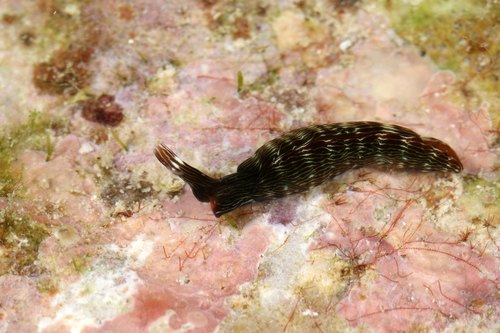
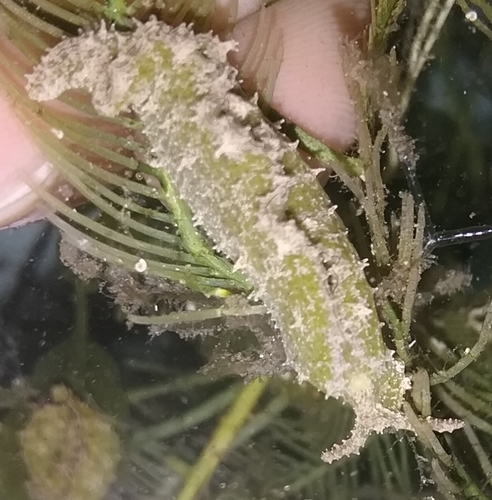
About Elysia marginata (Pease, 1871)
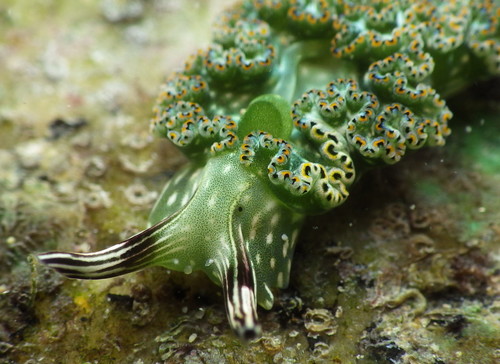
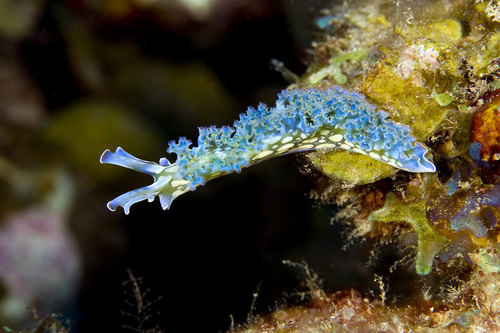
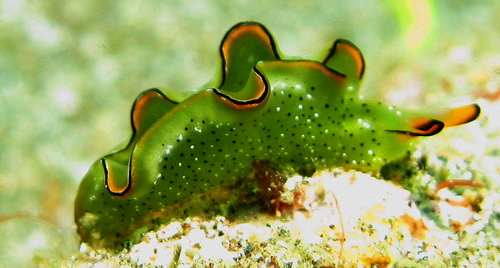
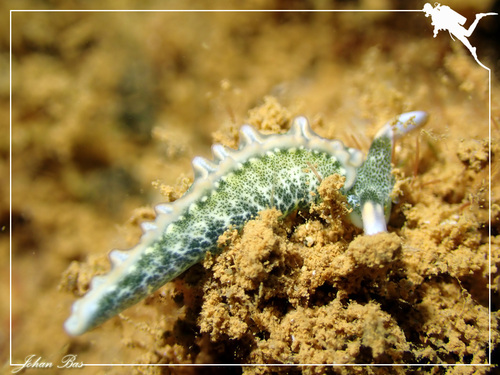
Elysia marginata has a green body marked with black and cream spots. It has tall, thin parapodia that feature a black band along the edge, with a submarginal orange band inside this black band. This species can be told apart from other Indo-Pacific species by an additional white band located between the orange submarginal band and the black marginal band. Elysia marginata has two distinct forms: a sedentary form that can reach up to 76 millimetres, or 3.0 inches, in length, and a migratory form that rarely grows longer than 25 millimetres, or 0.98 inches. While there are relatively few recorded distribution observations, Elysia marginata is widely distributed across the Indo-Pacific ocean region. It has been found at depths ranging from 0 to 10 metres, or 0 to 33 feet. This species was first documented off the coasts of the Hawaiian Islands and Tahiti. Like the related species Elysia ornata, Elysia marginata lives in shallow water, and feeds on Bryopsis algae growing on rocky substrates. It uses kleptoplasty to sequester chloroplasts from the algae it eats. These stolen chloroplasts are stored in Elysia marginata’s highly branched digestive gland. The digestive gland is lined with cells that maintain the ingested chloroplasts throughout the entire body of the sea slug. Unlike most other sea slugs, which can only autotomize small minor body parts, Elysia marginata and Elysia atroviridis are capable of completely autotomizing, or shedding, their heads from the rest of their body. Head separation in Elysia marginata occurs gradually over several hours, starting at a transverse groove on the body. This slow separation process suggests that autotomy in this species is a controlled adaptation to eliminate parasites. The behavior is too time-consuming to be an effective predator escape strategy, and studies introducing simulated predators did not trigger autotomy in this species. Like other sacoglossans, after separating from its original digestive system, Elysia marginata can survive entirely using energy from photosynthesis carried out by the sequestered chloroplasts it obtains via kleptoplasty. Like all other sacoglossan sea slugs, Elysia marginata is a hermaphrodite that reproduces sexually. It produces dimorphic eggs that develop into two distinct larval forms: small eggs that grow into planktotrophic larvae, which must feed on plankton to develop, and large eggs that grow into lecithotrophic larvae, which do not need to consume plankton to develop.