About Elymus elymoides (Raf.) Swezey
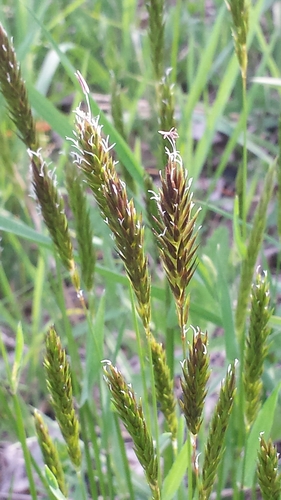
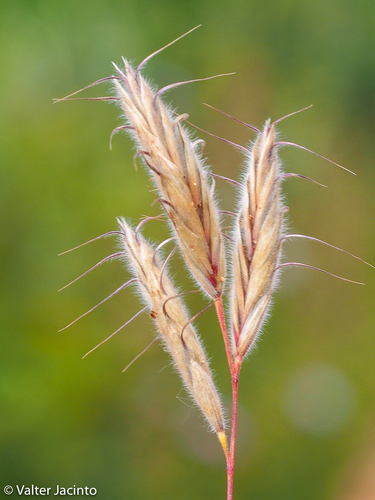
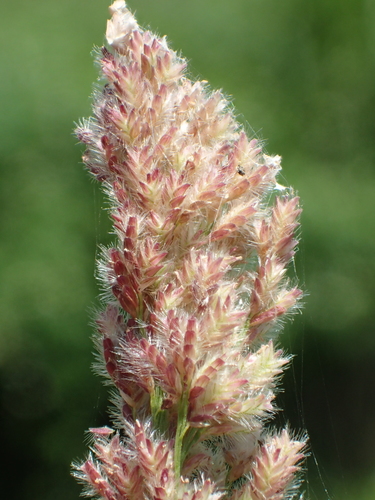
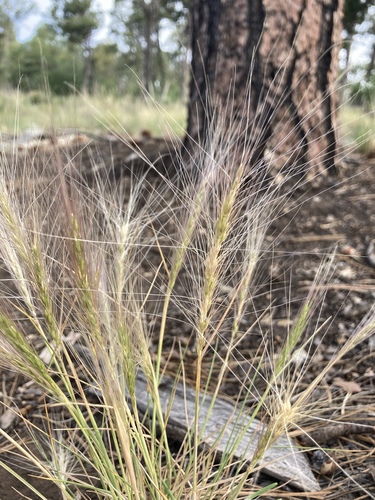
Elymus elymoides is a perennial bunch grass that reaches around 0.5 metres (1+1⁄2 feet) in height. It has erect solid stems with flat or rolled leaf blades. Its inflorescence grows up to 15 centimetres (6 inches) long, is somewhat stiff and erect, and holds spikelets 1 to 2 cm long not counting the awn. The awn may reach 9 cm (3+1⁄2 in) long, sticks straight out when the plant matures, gives the inflorescence a bottlebrush-like appearance, and aids wind dispersal of the plant's seeds. Early in the growing season, the spike is compact and reddish, in contrast to the mature structure.
The species is native to most of North America west of the Mississippi River, and grows in a range of ecosystems including the alpine zone, desert sage scrub, and valley grassland. This grass is rated as very good forage for sheep. It is most suitable for grazing in winter, when it is small and green. It becomes less palatable to livestock once its awns grow long and sharp at maturity. Elymus elymoides is a specific type of wild rye in the grass family Poaceae, which evolved 55 million years ago and includes major cereal grain crops such as wheat, rice, and barley. E. elymoides faces competitive pressure from invasive plant species, most notably cheat grass (Bromus tectorum). When E. elymoides grows alongside B. tectorum, it has lower fitness, which leads to negative natural selection acting on E. elymoides populations. This dynamic is most prominent in the Great Basin, where the dry environment makes water a limiting resource, so the two species compete for access to water. B. tectorum's competitive advantage may come from its ability to alter the scarce water supply of this ecosystem to suit its own needs. B. tectorum has similar negative effects on Elymus multisetus, which indicates that the trait driving reduced fitness in the presence of this invader is shared across the entire Elymus genus.
Elymus elymoides also competes with the invasive crested wheatgrass (Agropyron cristatum). When introduced to an area, crested wheatgrass negatively impacts mature E. elymoides, even though E. elymoides can compete effectively against crested wheatgrass at the seedling stage. The genus Elymus belongs to Poaceae, the grass family, which is the most economically important plant family to modern human civilization. When crested wheatgrass is used for site rehabilitation or restoration, co-planting a native bunch grass like E. elymoides can help prevent crested wheatgrass from forming a monoculture. Because E. elymoides populations decline when growing near certain other plant populations, squirreltail (Elymus elymoides) may grow better in a monoculture setting. This characteristic is supported by observations of another species, Elymus nutans. However, even though E. elymoides can grow successfully as a monoculture food source, growing it alone reduces carbon transfer and lowers soil health. To maintain a productive E. elymoides food source, growers must account for both the soil impacts of growing the species alone and its competitive responses when grown with other plants.