About Elops affinis Regan, 1909
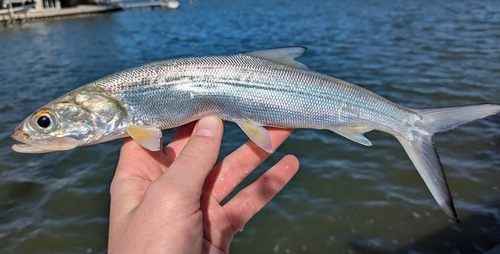
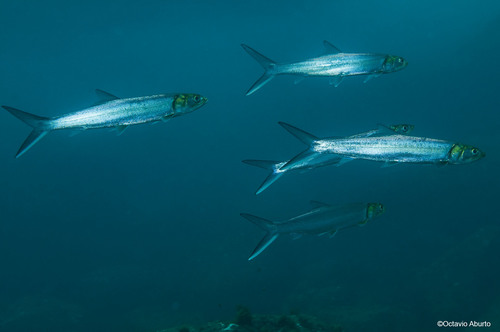
Elops affinis, commonly called the Pacific ladyfish or Pacific tenpounder, has a very rounded body with a terminal mouth, and well-developed gill structures called pseudobranchiae. Compared to most fish found in Arizona, this species has a higher number of dorsal fin rays, which range from 27 to 35. Anal fin rays typically number 13 to 19, and pelvic fin rays range from 12 to 16. Unlike nearly all other chordates, this species lacks a conus arteriosus, the tendinous band of tissue that gives rise to the pulmonary artery; this absence results in a much smaller pulmonary artery. The fish’s lateral lines are unbranched, and lateral line scales usually number between 95 and 120. All of its scales are silvery and cycloid, and the fish’s overall body color is also silvery, though yellow pigment may be present in the eyes. Key identification features include prominent auxiliary and inguinal processes. In the United States, this species is primarily restricted to the Southwest. Most recorded occurrences come from the Colorado River Delta and the Gulf of California, where the fish spawn before traveling northeast into Arizona. It was once common in California’s Salton Sea, but its population there has been slowly declining. During flood events, Pacific ladyfish enter the Lower Colorado River from the Gulf of California. They can be found in the Yuma portion of the Colorado River, with records of individuals occurring as far south as certain Mexican dams. Pacific tenpounders are primarily a marine species, so they require water with a higher salinity than most freshwater fish. This has led them to evolve efficient swimming abilities that let them navigate higher-salinity lagoons and estuaries. They are found at a maximum depth of around 10 m (33 ft). This species uses a wide range of water salinities throughout its spawning process. Under normal non-breeding conditions, Pacific tenpounders live in brackish water, but they travel into deep, fully salty ocean waters to breed. They deposit their eggs far from shore in plankton-rich areas, which provide nutrients for newly hatched juvenile fish. The larvae of this species look eel-like when they hatch, but can be distinguished by their forked tails. Young fish typically feed on crustaceans in brackish or coastal waters, which may explain the species’ instinct to move from the Gulf of California into the Lower Colorado River during flood conditions.