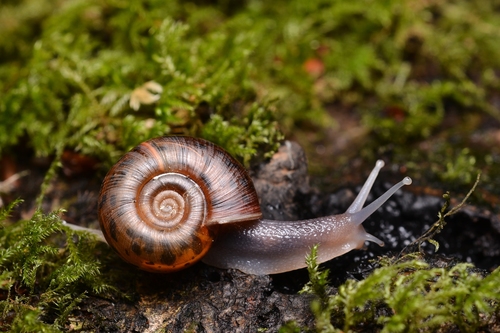
About Elona quimperiana (Blainville, 1821)
Elona quimperiana was originally described under the name Helix quimperiana by André Étienne d'Audebert de Férussac in 1821. Férussac's original French type description reads: QUIMPERINA, nobis. pl. fig. α) Nobis. pl. LXXVI (par erreur LXVI), fig. 2. Habit. Les bords de Briec l'Odet, près Quimper en Bretagne. Elle a été découverte par Mrs De Kermovan et Bonnemaison; Comm. Desmarest. In English translation, this means: "Habitat: Margin of Briec-de-l'Odet, near Quimper in Brittany. It was found by Messieurs De Kermovan and Bonnemaison."
For the shell of Elona quimperiana: the shell is umbilicate and planorboid in shape. The spire is slightly concave. The periphery is broadly rounded, corneous with a few varicoid white stripes. The shell has five or six whorls. The aperture is lunar and slightly oblique. The lip is white, expanded above, reflexed below, with the ends distant. The width of the shell is 20–30 mm, and the height of the shell is 10–12 mm.
This species is found in France and Spain, with a remarkably disjunct distribution limited to northwestern France (Brittany), northwestern Spain and the Basque Country. It lives in temperate and humid deciduous forests.
Like other pulmonate snails and slugs, the Quimper snail is hermaphrodite. Sexual maturity is reached at about two years of age. Mating takes place at mid-season, and egg-laying, usually underground, occurs in tiny natural soil tunnels. There are two annual breeding periods in Brittany, with hatching occurring in spring (April–May) and fall (September–October).

