About Elliotomyia chionogaster (Tschudi, 1846)
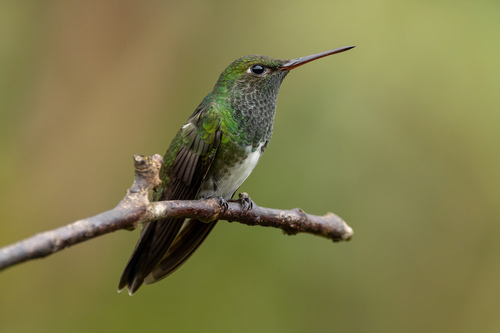
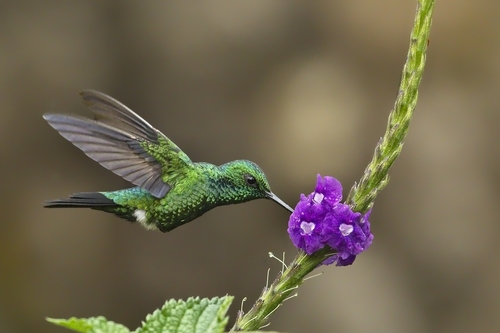
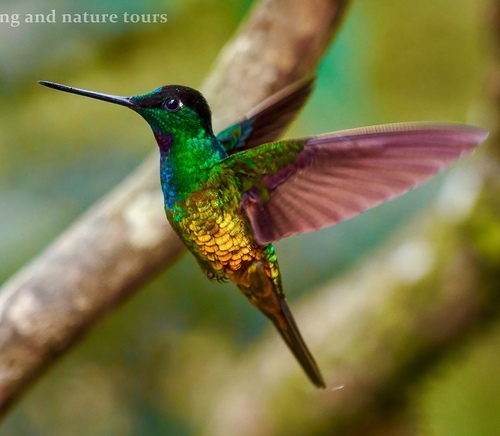
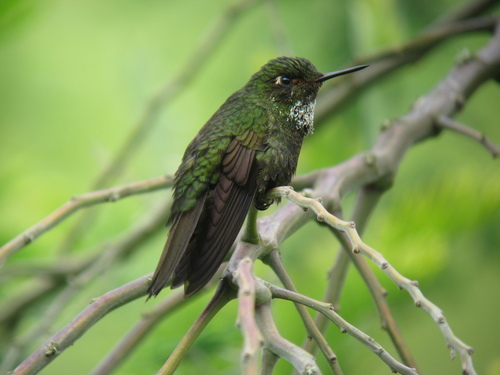
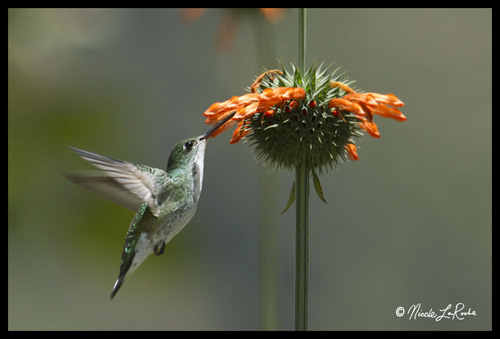
Elliotomyia chionogaster, commonly known as the white-bellied hummingbird, measures 9 to 12 cm (3.5 to 4.7 in) in total length. Males weigh 4.9 to 6.7 g (0.17 to 0.24 oz), while females weigh 4.5 to 6 g (0.16 to 0.21 oz). Both sexes of both recognized subspecies share a medium-length straight bill: the maxilla is blackish, and the mandible is reddish with a dark tip. For the nominate subspecies, adult males have brilliant light green upperparts, flanks, and chest. Their undersides from the chin to the undertail coverts are whitish, with golden-green spots on the sides of the throat, and sometimes faint green coloring on the undertail coverts. Their tail feathers are a brilliant grayish green to golden green; the outermost tail feathers have white inner webs. Adult nominate subspecies females are very similar to males, but their chin and throat are light cream and have more extensive spotting. Juvenile hummingbirds resemble adult females, with the cream throat color extending down to the belly. Subspecies E. c. hypoleuca differs from the nominate: both sexes have creamy rather than white underparts, and the white coloring on the inner webs of outer tail feathers is reduced. Female E. c. hypoleuca also have white tips on the outer three pairs of tail feathers. The nominate subspecies of white-bellied hummingbird occurs on the east slope of the Peruvian Andes, ranging between the departments of Amazonas and Cuzco. Subspecies E. c. hypoleuca occurs on the same east slope, starting from Puno Department in far southeastern Peru, extending south through Bolivia into northwestern Argentina as far as La Rioja Province, and east into the Brazilian state of Mato Grosso. This species lives in semi-open landscapes including forest edges, secondary forest, shrublands, cerrado, plantations, and gardens. It prefers relatively dry areas that host Cactaceae, Agave, or groves of Alnus or Eucalyptus. Most individuals are found at elevations between 450 and 2,000 m (1,500 and 6,600 ft), and they occasionally occur as high as 2,800 m (9,200 ft).