About Elimia virginica (Gmelin, 1791)
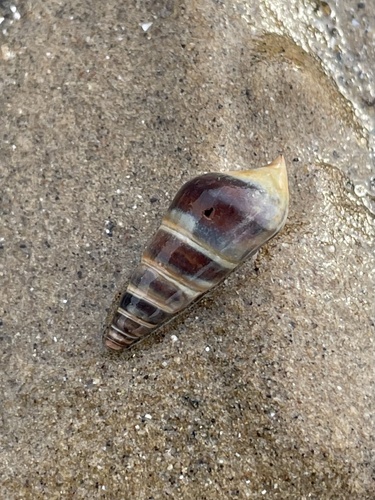
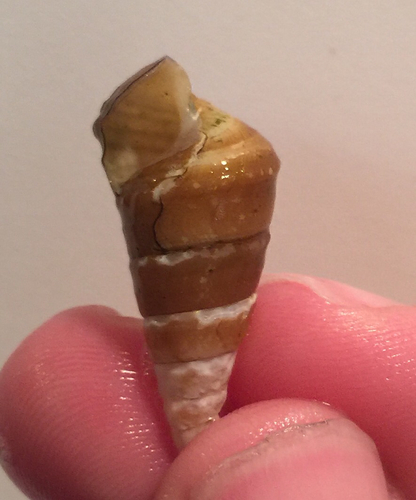
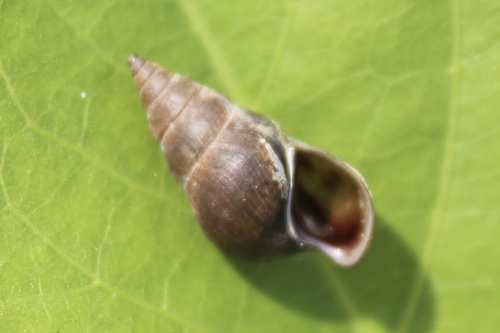
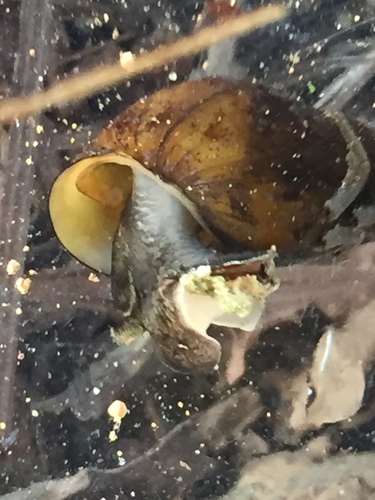
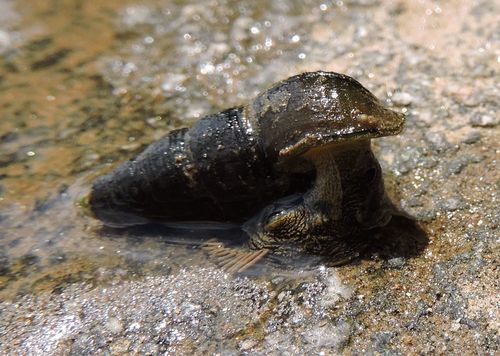
Elimia virginica (Gmelin, 1791) is a species of freshwater snail in the family Pleuroceridae, a group defined by thick, elongated snail shells. The operculum of this species is proteinaceous, corneous, and paucispiral, and it is withdrawn when the snail is active. Its shells are dextral, with a very high, narrow spire and very little space in the sutures, the incisions between shell whorls. This species has two distinct shell morphologies: one smooth, and one lirate, meaning finely lined or grooved. Shell coloration often varies between individual specimens; generally, Elimia virginica ranges from yellow to chestnut, and sometimes has two darker brown spiral bands. Juveniles, defined here as snails with an aperture height no greater than 7 mm, display this banding more often than adults. Specimens collected from New York State and the Connecticut River have shells between 27 and 33 mm high, with an aperture height of 9 to 12 mm. Elimia virginica is native to the United States east of the continental divide. It occurs in large Atlantic coast rivers of eastern North America, ranging from Massachusetts to Virginia. The northeastern edge of its native range is the lower Connecticut River. The species’ distribution is shrinking in its native Connecticut River, and it is considered rare in Connecticut. Its conservation status in the Connecticut River Watershed is ranked W1, meaning it is a rare species with 20 or fewer known occurrences across the watershed’s states. NatureServe conservation rankings for Elimia virginica across its range are: secure in the United States overall, presumed extirpated in Massachusetts, critically imperiled in Connecticut, vulnerable in New York, unranked in New Jersey, secure in Pennsylvania, apparently secure in Virginia, and unrankable in North Carolina. Outside its native range, Elimia virginica has spread to the Lake Ontario drainage in the United States, moving from Atlantic coast drainage through the Erie Canal. The first record of this species in the Great Lakes drainage dates to around 1856–1860, when it was found in the Erie Canal near Mohawk, New York. Populations expanded throughout the canal in the late 19th century, and reached Buffalo at the mouth of Lake Erie. This species was recorded in Oneida Lake, New York, in the 1960s, and it is considered established in the Lake Ontario drainage. However, although introduced to this area, Elimia virginica has been largely outcompeted by Bithynia tentaculata, another introduced snail native to the Palaearctic ecozone. As a result, Elimia virginica is now virtually absent from the Oswego drainage, and its abundance is likely reduced in other introduced localities due to this interspecific competition. There are no known negative impacts from this species’ introduction to new water bodies. Elimia virginica lives in freshwater rivers and streams with cobble and boulder bottoms. Pleurocerids as a group are typically found in lotic erosional environments, including riffles or shoals with rock or sand substrate, and are especially common on rocks in slower sections of medium-sized reaches. Elimia virginica most often inhabits slow to medium velocity rivers and streams with firm, clean gravel, cobble, and rock substrate. Like other pleurocerids, it is sensitive to abiotic stresses, and cannot tolerate siltation. In Connecticut, where the species sits at the edge of its native range, it is most likely restricted only to hard water habitats. Surveys in the Connecticut River found this snail in regions with water temperatures up to 27.5 °C, dissolved oxygen between 7 and 14 ppm, CaCO₃ concentration from 42 to 160 ppm, pH from 7.6 to 9.0, and CO₂ concentration from 0 to 10 ppm. At some of these surveyed sites, population abundance was very low and/or decreasing, particularly under conditions of high water temperature and high alkalinity. Elimia virginica is dioecious. It lays eggs from spring through summer, most commonly in June and July. Unlike softer-shelled physid snails, Elimia virginica grows very slowly. Along with Leptoxis carinata, it has the lowest intrinsic rate of population increase in its native environment, meaning its populations grow very slowly. Individuals typically reach sexual maturity within one year, and can live up to 5 years.