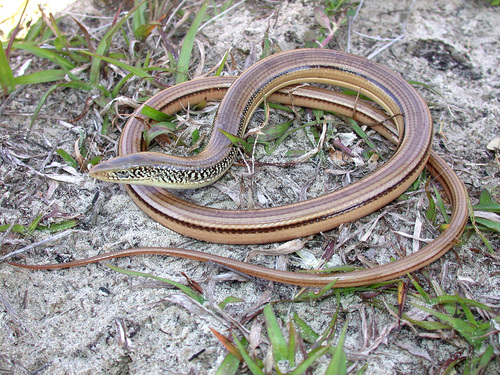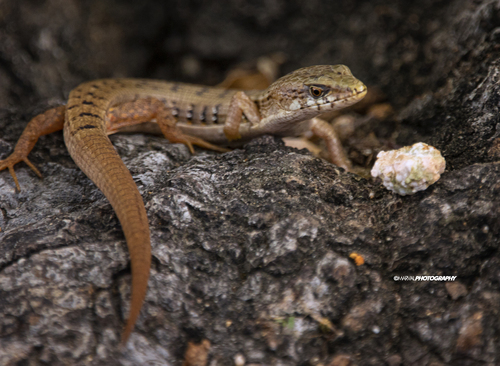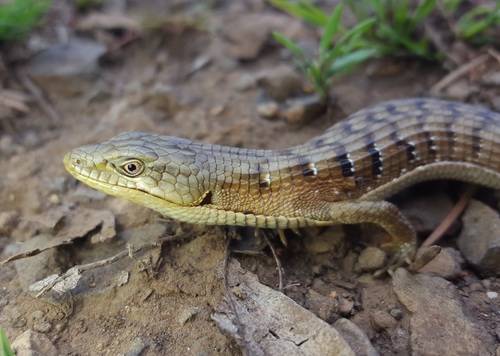
About Elgaria multicarinata (Blainville, 1835)
The southern alligator lizard (Elgaria multicarinata) has a snout-to-vent length of 3 to 7 inches (8 to 18 cm); when including the tail, its total length can reach up to 1 foot (30 cm). It has a round, thick body with small legs, and a long, somewhat prehensile tail that can grow to twice the length of its body. Like many lizard species, southern alligator lizards can drop their tail when attacked, which likely gives them an opportunity to escape. On average, this species lives 10 to 15 years, and survives well in captivity. Its dorsal coloration is variable, and can be brown, gray, green, or yellowish, often with red blotches along the middle of the back. It usually has between 9 and 13 dark crossbands across the back, sides, and tail, with adjacent white spots. These crossbands may be very distinct, or obscured by reddish or yellowish coloration. The scales of E. multicarinata are keeled on the back, sides, and legs. There are 14 rows of scales across the back at the midpoint of the body. A band of smaller granular scales separates the larger scales of the back and stomach, forming a fold along each side of the lizard's body. These folds allow the body to expand to accommodate food or developing eggs. The southern alligator lizard is native to the Pacific coast of North America, with a range extending from the U.S. state of Washington down to Baja California. It can be found across a wide variety of habitats, including grassland, open forest, chaparral, suburban and urban areas, and even extends into desert habitat along the Mojave River. This species is especially common in foothill oak woodlands, and is often found hiding under rocks, logs, or other surface cover. Southern alligator lizards are frequently found near human settlements, and most often forage during the mornings and evenings. They are commonly seen in or around suburban yards and garages. E. multicarinata is known for aggressive self-defense, and will bite and defecate if handled by humans. Mating typically occurs in spring, between April and May, though populations in warmer regions may breed year-round. Females usually lay eggs between May and June, and eggs hatch in late summer and early fall. Females can produce two clutches of eggs per year, and typically lay eggs in decaying wood or plant matter to keep the eggs warm. Females guard their eggs until they hatch.