About Eleutherodactylus coqui Thomas, 1966
Full-grown male common coquís (Eleutherodactylus coqui Thomas, 1966) measure 30 to 37 mm (1.2 to 1.5 in) from snout to vent, with an average of 34 mm (1.3 in), while full-grown females measure 36 to 52 mm (1.4 to 2.0 in), with an average of 41 mm (1.6 in). The elevation of the coquí's habitat affects their size, with larger coquís found in areas at higher elevation. Sexual size difference arises from the additional energy consumption males use for breeding behavior.
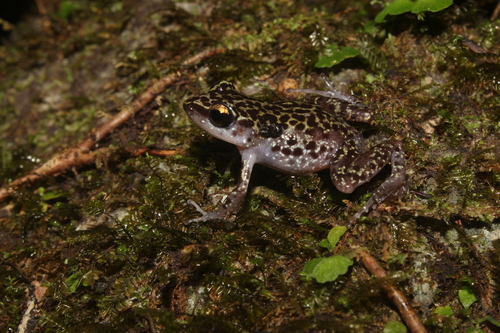
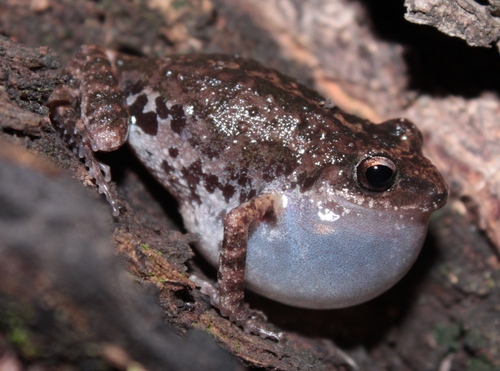
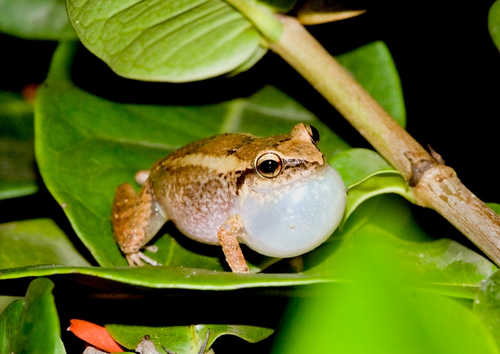
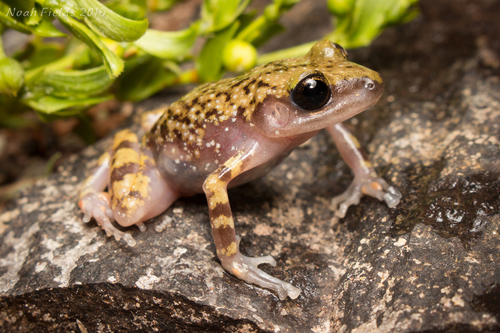
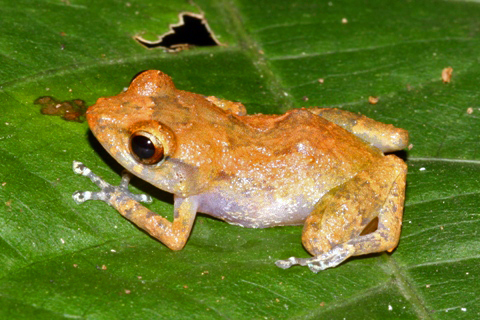
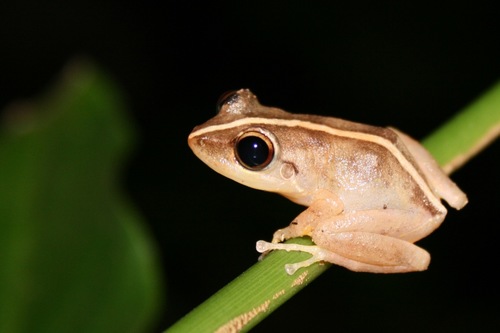
Coquís have mottled muddy-brown coloration on their dorsal side, rust-tan flanks, and a light-gray belly. As tree frogs, they have sticky pads on their toe tips that help them adhere to moist or slippery surfaces. They do not have webbed feet and are not adapted for swimming.
In the wild, the common coquí can live up to 6 years, but most adults do not survive past one year, and the species is generally considered to have a relatively short lifespan, with most individuals living less than a year. A population dynamics study found the species has a high mortality rate, with only a small proportion of individuals surviving to adulthood. This high mortality is likely caused by a variety of factors including predation, disease, and competition for resources.
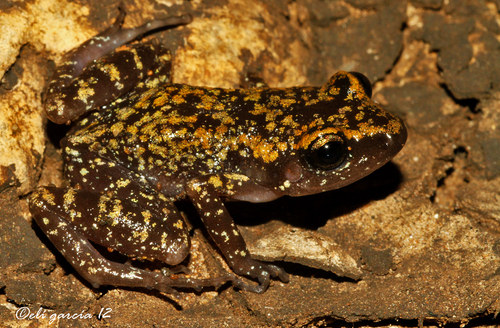
One study by Lawrence and Stewart explored spatial and temporal variation in color pattern morphology in coquí frog populations in northeastern Puerto Rico. The researchers recorded pattern morphs for 9,950 frogs captured at nine locations over 25 years. Their data revealed 21 distinct pattern morphs, including stripes, bars, and spots. Significant differences in morph frequencies were seen between locations: longitudinal stripes were more common in grassland, while spot and bar morphs were more common in forests. Analysis also showed temporal shifts in morph frequencies immediately after Hurricane Hugo in 1989, indicating that major habitat disturbances influence this pattern polymorphism.
The researchers suggested the polymorphism is maintained at least in part by local habitat matching driven by selection pressure from visual predators. The coquí is preyed on by various vertebrate and invertebrate predators, and the study explored evolutionary adaptations in color and pattern variation that reduce predation risk. It discussed the concepts of camouflage, cryptic coloration, and disruptive patterns in the context of predator-prey interactions. The researchers hypothesized that the pattern polymorphism seen in coquí frogs is the result of selective pressures from visual predators, primarily birds, which develop search tactics and perceive the color patterns of their amphibian prey. The paper also discussed potential factors influencing pattern polymorphisms, including apostatic selection and local habitat matching. The authors suggested these factors, along with the likely heritability of pattern morphs, contribute to maintaining multiple patterns in the coquí population.
Common coquís are native to the islands of Puerto Rico, Vieques, and Culebra, where they are widespread and abundant; the only notable exception is Puerto Rican dry forests, where the species is rarer. The common coquí is the most abundant frog in Puerto Rico, with estimated densities of 20,000 individuals per hectare. Densities fluctuate based on season and habitat: generally, densities are higher during the latter half of the wet season and decrease during the dry season.
The species is a habitat generalist that occurs in a wide range of habitats, including mesic broadleaf forests, mountains, and urban areas. They can be found in bromeliads, tree holes, and under trunks, rocks, or trash. Since the species does not require bodies of water to reproduce, they can be found at most altitudes as long as sufficient moisture is available. In Puerto Rico, they are found from sea level up to a maximum of 1,200 m (3,900 ft). Adults are generally found at higher altitudes than juveniles. Common coquís often cohabitate with humans, and can commonly be found in homes and parks due to their unrestricted habitat use. They occupy the forest understory from all elevations up to the canopy.
The species has been introduced to Colombia, Hawaii in the United States, and the Virgin Islands. It has become a densely populated invasive species in the Hawaiian Islands, where it was accidentally introduced in the late 1980s, most likely as a stowaway on potted plants, and quickly established itself on all four major Hawaiian islands. It is now considered a pest species by the State of Hawaii, and in 2000 it was added to the IUCN's list of 100 of the world's worst invasive species.
As an invasive species, it can reach up to 91,000 individuals per hectare, almost five times its maximum native density in Puerto Rico. Higher densities in its invaded range are likely supported by release from native predators, a lack of interspecific competitors, and abundant food availability. In Hawaii, they have been found at a maximum elevation of 1,170 m (3,840 ft) above sea level. They were previously introduced to the Dominican Republic, Louisiana, and Florida, but these populations have since been eradicated.
Common coquís in areas where their density exceeds 51,000 per hectare can consume over 300,000 invertebrates per night. Because of their large populations, Hawaii is concerned about both economic and ecological impacts. The common coquí currently costs the state nearly 3 million dollars a year. Its spread commonly occurs through the nursery trade, so many people are reluctant to buy plants from nurseries that might be infected. Nurseries have begun to perform quarantines and de-infestations to improve their business. Coquis also lower real estate values in residential neighborhoods, as many buyers avoid houses where sleep would be disturbed by the common coquí's call, which can reach 73 dB.
A study conducted by Karen H. Beard performed a quantitative analysis of adult and juvenile Eleutherodactylus coqui habitat preferences in Puerto Rico, focusing on Luquillo Experimental Forest, a subtropical wet forest where the coquí is the most abundant nocturnal species. The research included two surveys: one to quantify potential habitat range and another to quantify habitat use. The researchers found that coquis used most available habitats, but adults and juveniles had different preferences for plant species, habitat structural components, and height from the forest floor.
Quantitative analysis showed that adult and juvenile coquis had opposite associations with important forest plant species such as Prestoea montana and Heliconia caribaea. Adults had a negative association with leaves but a positive association with leaf litter, while juveniles showed the opposite trend. There were also differences in height distribution: adults were more evenly distributed and preferred heights around 1.1 m, while juveniles preferred heights closer to the forest floor. The researchers used goodness-of-fit G-statistics to check if coquis had a random distribution relative to plant species, habitat structural components, and height. The results indicated nonrandom spatial distributions, confirming that coquis have specific habitat preferences.
Experiments have investigated the diet and foraging behavior of invasive Eleutherodactylus coqui in Hawaii, and their potential impact on local invertebrate communities. The study explored prey preferences of different life stages (subadults, adult males, and adult females) across multiple sites and microhabitats. The researchers also aimed to identify the types and amounts of endemic invertebrates consumed by E. coqui, to clarify the potential ecological consequences of their invasion.
The experimental design included collection and analysis of 696 E. coqui individuals from 11 different sites in Hawaii. Specimens were categorized by sex and life stage, and their stomach contents were examined to identify and quantify the invertebrates they consumed. Several methods were used to collect invertebrates from different microhabitats: flying insects were captured with UV light traps, foliage invertebrates were collected from understory plants, and litter invertebrates were extracted. Statistical analyses including ANOVAs and PCAs were used to assess microhabitat use, prey diversity, and prey selection across sites and life stage classes.
Subadults and adults had different microhabitat preferences: subadults were often found on leaves, while adults were distributed more evenly across trunks and leaves. Diet composition varied between life stages, with subadults consuming more prey and having greater prey diversity than adults. Certain invertebrate groups, including ants and amphipods, were overrepresented in stomach contents compared to environmental samples, indicating these are preferred prey. The study concluded that endemic invertebrates may be vulnerable to E. coqui predation.
Common coquís reproduce year-round, but breeding activity peaks around the wet season. Females usually lay between 16 and 40 eggs four to six times each year, at intervals of about eight weeks. Eleutherodactylus coqui has internal fertilization, and embryos develop inside large yolk-rich eggs that provide all nutrients required until hatching, when they emerge as fully formed froglets. Males guard the eggs from predators, including other common coquís and Subulina snails. The gestation period for coquís is 17 to 26 days. The time from egg to sexually mature coquí is around eight months.
Unlike most frogs that lay their eggs in water, coquís lay their eggs on palm tree leaves or other terrestrial plants. Abandoned bird nests are also used as nesting sites by E. coqui. The bananaquit, Puerto Rican bullfinch, and Puerto Rican tody share nests with the coquí. This reproductive method allows coquís to live in forests, mountains, and other habitats without direct dependence on water. Because eggs are laid on land, coquís skip the tadpole stage, developing limbs inside their eggs instead of undergoing metamorphosis as an aquatic larva. A fully independent froglet emerges from the egg, with a small tail that is lost shortly after hatching. This direct development has allowed the coquí to become a successful terrestrial colonizer in tropical areas. Eggs hatch within eight weeks, and individuals reach reproductive maturity within one year. The common coquí uses an egg tooth, formed by members of the genus Eleutherodactylus, to hatch from the egg.
Both males and females fight off intruders from their nests by jumping, chasing, and sometimes biting. Males are the primary caretakers of the eggs. They provide protection and maintain moist environments through skin contact, and will leave during very dry periods to collect more moisture for their offspring.
Males begin their mating calls while perching above ground level. The coquí's call is used both to attract mates and to establish territorial boundaries. A coquí may enter another's territory and challenge the resident by starting its call, after which the two may engage in a sort of singing duel that can last for several minutes. The first individual to fail to keep up with the cadence is considered the loser and leaves the area without physical violence. This behavior is consistent across different coquí species, which have distinctive calls, so it is possible to hear a duel where one coqui sings "COQUI" and another sings "COQUIRIQUI".