About Elephas maximus Linnaeus, 1758
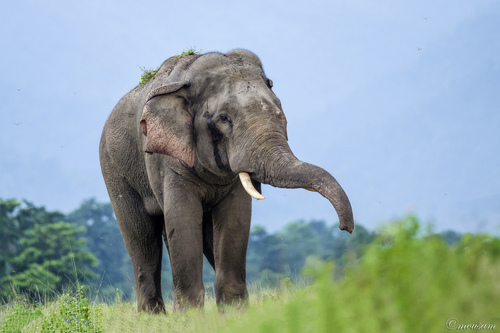
The Asian elephant (Elephas maximus Linnaeus, 1758) is generally smaller than the African bush elephant, with its highest body point located on the head. Its back is either convex or level. It has small ears with dorsal borders folded laterally, up to 20 pairs of ribs and 34 caudal vertebrae. Each forefoot has five nail-like structures, and each hind foot has four. Unlike the flat front of African elephants, the Asian elephant’s forehead has two hemispherical bulges. Its long trunk (proboscis) has only one fingerlike tip, compared to the two tips of African elephants. Because of this, Asian elephants rely more on wrapping around food items and squeezing them into their mouths instead of grasping with the trunk tip, and they have greater muscle coordination that allows them to perform more complex tasks. Female Asian elephants (cows) usually do not have tusks; if small tusks (called "tushes") are present, they are barely visible and only seen when the mouth is open. Some males (bulls) may also lack tusks; these tuskless individuals are called "makhnas" and are especially common among the Sri Lankan elephant population. Recorded tusk sizes vary: a tusk from an 11 ft (3.4 m) tall elephant killed by Sir Victor Brooke measured 8 ft (2.4 m) long, nearly 17 in (43 cm) in circumference, and weighed 90 lb (41 kg). This weight was exceeded by a shorter tusk around 6 ft (1.8 m) long that weighed 100 lb (45 kg), and there are reports of tusks weighing over 150 lb (68 kg). Asian elephant skin is usually grey, and may be covered by soil from dusting and wallowing. Their wrinkled skin is movable, contains many nerve centers, and is smoother than the skin of African elephants. Depigmentation may occur on the trunk, ears, or neck. The average combined thickness of the epidermis and dermis across the body is 18 mm (0.71 in); skin on the dorsum is 30 mm (1.2 in) thick, providing protection against bites, bumps, and adverse weather. Skin folds increase surface area to help with heat dissipation. Asian elephants tolerate cold better than excessive heat. Their skin temperature ranges from 24 to 32.9 °C (75.2 to 91.2 °F), and average body temperature is 35.9 °C (96.6 °F). Asian elephants are distributed across the Indian subcontinent and Southeast Asia, ranging from India in the west to Borneo in the east, and from Nepal in the north to Sumatra in the south. They inhabit grasslands, tropical evergreen forests, semi-evergreen forests, moist deciduous forests, dry deciduous forests, dry thorn forests, as well as cultivated areas, secondary forests, and scrublands. Across these habitat types, elephants occur from sea level up to over 3,000 m (9,800 ft). In the eastern Himalaya of northeast India, they regularly move to elevations above 3,000 m (9,800 ft) in summer at a few sites. In Bangladesh, some isolated populations survived in the southeast Chittagong Hills in the early 1990s. In Malaysia’s northern Johor and Terengganu National Park, two satellite-tracked Asian elephants spent most of their time in secondary or logged-over forest, and traveled 75% of the time within an area less than 1.5 km (0.93 mi) from a water source. In China, Asian elephants only survive in the prefectures of Xishuangbanna, Simao, and Lincang in southern Yunnan; as of 2020, the estimated population there was around 300 individuals. As of 2017, India’s estimated wild population made up nearly three-fourths of the world’s extant Asian elephant population, at 27,312 individuals. In 2019, India’s Asian elephant population was estimated to have increased to between 27,000 and 29,000 individuals. As of 2019, the global wild population was estimated at 48,323 to 51,680 individuals. Asian elephants are crepuscular. They are classified as megaherbivores and consume up to 150 kg (330 lb) of plant matter per day, with around 50 to 75% of each day spent eating. They are generalist feeders that act as both grazers and browsers, and have been recorded feeding on at least 112 different plant species. The most commonly consumed plants belong to the order Malvales, as well as the legume, palm, sedge, and true grass families. They browse more often in the dry season, and bark makes up a major part of their diet during the cool part of this season. They drink at least once a day and are never far from a permanent source of fresh water. They need 80 to 200 litres of water a day, and use even more for bathing. They will sometimes scrape soil to obtain clay or minerals. Cows and calves travel together in groups, while bulls disperse from their mothers when they reach adolescence. Bulls are either solitary or form temporary "bachelor groups". Cow-calf units are generally small, typically consisting of three adult (most likely related females) and their offspring, though larger groups of up to 15 adult females have also been recorded. Seasonal aggregations of 17 individuals including calves and young adults have been observed in Sri Lanka’s Uda Walawe National Park. Until recently, Asian elephants were thought, like African elephants, to be led by older adult females called matriarchs. It is now recognized that cows form extensive, very fluid social networks with varying degrees of association between individuals, and social ties are generally weaker than those of African bush elephants. Unlike African elephants, which rarely use their forefeet for anything other than digging or scraping soil, Asian elephants are more agile at using their feet together with the trunk to manipulate objects. They can sometimes exhibit violent behavior. Asian elephants produce three basic sounds: growls, squeaks, and snorts. Basic growls are used for short-distance communication. During mild arousal, growls resonate in the trunk and become rumbles; for long-distance communication, growls escalate into roars. Low-frequency growls are infrasonic and produced in many contexts. Squeaks have two forms: chirpings and trumpets. Chirping consists of multiple short squeaks and signals conflict and nervousness. Trumpets are lengthened, louder squeaks produced during extreme arousal. Snorts signal changes in activity, and increase in loudness during mild or strong arousal. When an elephant bounces the tip of its trunk during strong arousal, it creates booms that serve as threat displays. Elephants can distinguish low-amplitude sounds. Rarely, tigers have been recorded attacking and killing calves, especially when calves become separated from their mothers, stranded from their herd, or orphaned. Adult Asian elephants are largely invulnerable to natural predation. There is a single anecdotal report of a mother Asian elephant allegedly being killed alongside her calf, but this account is contested. In 2011 and 2014, two instances of tigers successfully killing adult Asian elephants were recorded: one by a single tiger in Jim Corbett National Park that killed a 20-year-old young adult cow, and another that killed a 28-year-old sick adult bull in Kaziranga National Park further east, which was taken down and eaten by several tigers hunting cooperatively. Asian elephants can distinguish between the growls of larger predators like tigers and smaller predators like leopards; they react to leopards with less fear and more aggression. Reproduction in Asian elephants relies on the production and perception of signaling compounds called pheromones, which are transmitted through various bodily fluids. Pheromones are commonly released in urine, and in males they are also found in special secretions from the temporal glands. Once these signals are integrated and perceived, they give the receiver information about the reproductive status of the sender. If both individuals are ready to breed, ritual reproductive behavior occurs and sexual reproduction proceeds. Bulls will fight one another to gain access to estrus cows, but strong fights over access to females are extremely rare. Bulls reach sexual maturity around 12 to 15 years of age. Between 10 and 20 years old, bulls experience an annual phenomenon called "musth", a period where testosterone levels are up to 100 times higher than during non-musth periods, and bulls become aggressive. During musth, pheromone-containing secretions are produced by the paired temporal glands located on the head between the lateral edge of the eye and the base of the ear. The aggressive behaviors seen during musth are linked to varying amounts of frontalin (1,5-dimethyl-6,8-dioxabicyclo[3.2.1]octane) throughout the maturation process of bulls. Frontalin is a pheromone first isolated in bark beetles, but it is also produced by bulls of both Asian and African elephants. The compound can be excreted through urine as well as the bull’s temporal glands to enable reproductive signaling. During musth, increased concentrations of frontalin in a bull’s urine communicate his reproductive status to female elephants. Like other mammals, hormone secretion in female elephants is regulated by an estrous cycle. This cycle is regulated by surges in Luteinizing hormone that occur every three weeks, an estrous cycle pattern also seen in African elephants that is not known to occur in other mammals. The first Luteinizing hormone surge is not followed by ovulation (egg release from the ovaries), but some female elephants still display expected mating behaviors during this surge. Female elephants give ovulatory cues using sex pheromones. A main component of these cues, (Z)-7-dodecen-1-yl acetate, is also a sex pheromone in numerous insect species. In both insects and elephants, this chemical compound acts as an attractant to assist the mating process. In elephants, the chemical is secreted through urination, which helps attract bulls for mating. Once detected, the chemical stimulates the bull’s vomeronasal organ, providing information about the female’s maturity. Reproductive signaling between male and female elephants is transmitted through olfactory cues in bodily fluids. In males, increased frontalin levels during musth heighten their sensitivity to the (Z)-7-dodecen-1-yl acetate produced by female elephants. Once the chemical is perceived by receptors in the trunk, a sequence of ritualized behaviors follows. Male responses vary based on both the stage of development and the temperament of the elephant. This process of receiving and processing signals through the trunk is called flehmen. Differences in body movement give cues to indicate whether a male is interested in breeding with the female that produced the secretion. A bull ready to breed will move closer to the urine, and an erection response sometimes occurs. A bull not ready to breed will act timidly and try to move away from the signal. In addition to reproductive communication, chemosensory signaling is used to facilitate same-sex interactions. When less developed males detect pheromones from a male in musth, they often retreat to avoid contact with aggressive behavior. Female elephants have also been observed communicating with each other through pheromones in urine. The purpose of this same-sex communication is still being investigated, but clear differences exist in signaling strength and receiver response across different stages of the estrous cycle. The gestation period for Asian elephants is 18 to 22 months, and cows usually give birth to one calf, with twins occurring only occasionally. The calf is fully developed by the 19th month, but remains in the womb to grow so that it can reach its mother to feed. At birth, a calf weighs around 100 kg (220 lb), and is suckled for up to three years. After a female gives birth, she usually does not breed again until the first calf is weaned, resulting in a four to five-year birth interval. During this period, communication between mother and calf primarily occurs through temporal means. Male calves have been recorded developing sex pheromone-producing organs at a young age. Early maturity of the vomeronasal organ allows immature elephants to produce and receive pheromones. It is unlikely that integration of these pheromones produces a flehmen response in calves. Female calves stay with the herd, while mature males are chased away. Female Asian elephants reach sexual maturity around 10 to 15 years of age and continue growing until they are 30 years old. Males reach full maturity after 25 years of age and grow constantly throughout their life. The average life expectancy of an Asian elephant is approximately 60 years. Some individuals have been recorded living into their late 80s. The generation length of the Asian elephant is 22 years.