About Elegia tectorum (L.f.) Moline & H.P.Linder
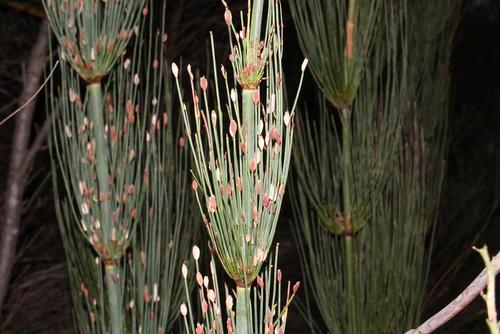
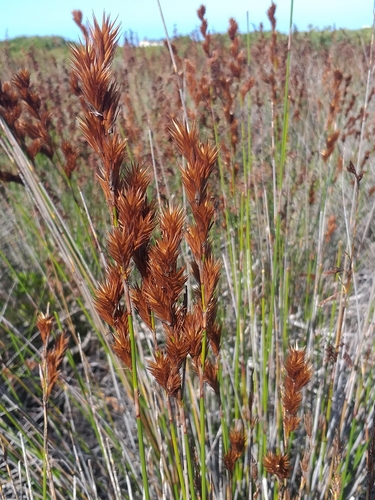
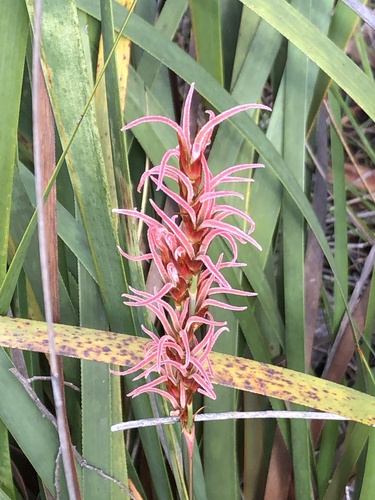
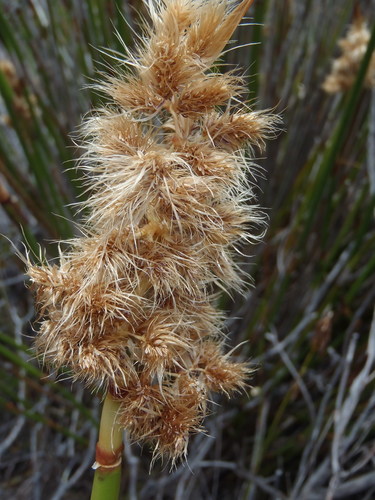
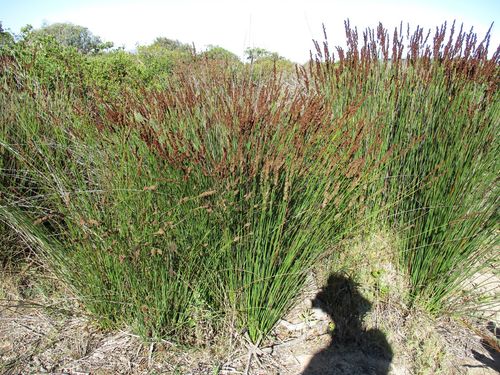
Elegia tectorum, previously classified under the synonyms Chondropetalum tectorum and Restio tectorum, is commonly known as Cape thatching reed, or dakriet in Afrikaans. It is a member of the restio family, Restionaceae. This tufted perennial grows to between 1.5 and 2.25 meters, and has deciduous leaf sheaths. Its flowers are less than 3 mm long, and its petals are either smooth or hairy in the upper half. E. tectorum grows in marshes and seeps on deep sand in the Western Cape and Eastern Cape of South Africa. The species was first documented by Carl Linnaeus the Younger. In 1838, Irish botanist William Henry Harvey (documenting it under the name R. tectorum) recorded its use as thatching material, and for making brooms and baskets. Historically, only the taller forms of the species growing around Malmesbury were used for thatching; the more popular thatching reed at the time was Thamnochortus insignis. Carl Peter Thunberg also noted the species' use in thatching in 1793, and English botanist John Lindley did the same in 1846. Thunberg recorded that the Dutch East India Company ran a farm at Zeekoe Valley, 17 km south-southeast of the Castle of Good Hope, where this reed was cultivated. He described its traditional processing and use at the Cape of Good Hope as follows: After cutting a bundle or sheath with a sickle, it is held by the top, and all shorter loose stalks are shaken out. The remaining long stalks are then spread in rows to dry, then tied into bundles. This reed was commonly used to thatch roofs in both urban and rural houses at the Cape, and sometimes whole huts were built with it. A thatched roof made from this reed lasts 20 to 30 years, and would last longer if the south-east wind did not blow large amounts of dirt between the thatch, which causes it to rot more quickly. E. tectorum was later reclassified as Chondropetalum tectorum, but a 2005 cladistic analysis by Moline and Linder found that the genera Chondropetalum and Dovea were nested within the genus Elegia, leading to its current accepted name. When grown in cultivation in the United Kingdom, this plant has received the Royal Horticultural Society's Award of Garden Merit.