About Eledone cirrhosa (Lamarck, 1798)
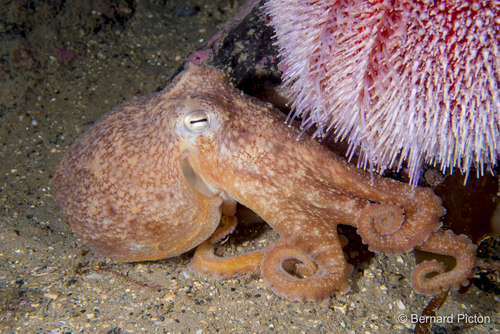
Eledone cirrhosa has a broad, ovoid-shaped mantle, and can reach a total length including arms of up to 50 cm (20 in). Its head is narrower than the rest of its body, with a filament over each eye. The dorsal surface of this octopus ranges from yellowish or reddish-orange to reddish-brown, with diffuse rust-brown patches, and its underside is white. Its skin is covered with very fine, closely set granulations, with larger warts interspersed among them. Its relatively short arms have a single series of suckers, and are held with the tips lightly curled when at rest — this feature gives the species its common name. The maximum weight of this species is 1 kilogram (2.2 lb) in the more southerly parts of its distribution, and 2 kilograms (4.4 lb) in the northern part. The curled octopus is mainly found at depths between 0 and 150 m (0 and 492 ft), and may occur as far down as 800 m (2,600 ft). It lives in the northeast Atlantic Ocean, including the English Channel, the North Sea, and the Mediterranean Sea. In recent years, North Sea populations of this species have increased, probably due to overfishing of large predatory fish such as Atlantic cod. This increase has affected crab and lobster fisheries, because the curled octopus readily enters fishing pots to take the bait or the catch. In Scottish seas, E. cirrhosa is infrequently caught when trawling over rocky substrates, and is more frequently captured when fishing over sandy or muddy substrates. A survey using different methods found that Eledone cirrhosa was common and widespread throughout the Scottish inshore waters covered by fishing activity, from the shoreline down to 140 m, across substrates including rocky, stoney, sandy and muddy. Specimens were caught throughout the year, but the species is most common in inshore waters during the summer months, and moves further offshore to trawling grounds in October through December.

